Thessa as a doctoral thesis tool

By selecting a degree programme you are able to see the general content as well as the possible degree programme-specific content. You do not have to select a degree programme to see the Open University's instructions.

The University of Helsinki uses the electronic Thessa tool for the planning, supervision and monitoring of doctoral thesis projects. With Thessa, you can plan your research project, track your progress and draw up a supervision plan with your supervisors. Your supervisors as well as the members of your thesis committee can also use Thessa to check on your progress. The instructions on this page help you start using Thessa at the outset of your doctoral studies.

What is Thessa?

Thessa is an electronic tool for the planning, supervision and monitoring of doctoral thesis work at the University of Helsinki. It supports doctoral researchers, supervisors and thesis committees in setting the goals for doctoral thesis work, monitoring its progress and documenting the work throughout doctoral education.

Thessa is used to draw up and approve supervision plans, maintain information on the progress of doctoral thesis projects and prepare annual reports and thesis committee meetings. When updated regularly, Thessa helps to keep all key parties up to date on the goals, interim stages and agreed matters associated with doctoral thesis work.

At the University of Helsinki, all doctoral researchers must ensure that the information pertaining to the progress of their doctoral thesis work, supervision and thesis committee activities remains up to date in Thessa. Current information supports systematic progress as well as collaboration between doctoral researchers, supervisors and thesis committees throughout the doctoral thesis process.

While these guidelines are primarily targeted at doctoral researchers, they also contain information useful to supervisors and thesis committee members.

Using Thessa

Doctoral researchers begin to use Thessa after receiving their right to study. Doing so right at the beginning of studies brings details related to the planning, supervision and monitoring of doctoral thesis work in one place.

Getting started with Thessa is straightforward: 

  1. Open Thessa in your browser. 
  2. Log in using your University username and password. 
  3. Start updating your details.

Thessa is based on three different features:

  1. Supervision plan – A joint plan for the supervision of doctoral theses and related responsibilities
  2. My PhD project – Planning the progress of doctoral thesis work, studies and project, related updates
  3. Reports – Annual monitoring of doctoral thesis work and preparations for thesis committee meetings

Supervisors and thesis committee members in Thessa

Doctoral programmes’ staff will handle connecting doctoral researchers and supervisors in Thessa. If there are errors or flaws in your supervisor information, please contact your doctoral programme’s senior advisor.

You need to invite your thesis committee members to Thessa yourself.

Keep your details up to date

Thessa should be updated regularly, as it will use the entered details to automatically generate most of the content for annual reports. Up-to-date information helps doctoral researchers, supervisors and thesis committees establish a shared understanding of the progress of doctoral thesis work and the subsequent goals.

Visibility of information in Thessa

In addition to doctoral researchers, supervision plans and annual reports are available in Thessa to their supervisors, thesis committee members and support staff for doctoral education. This way, doctoral researchers, supervisors and thesis committees share an up-to-date understanding of the progress of doctoral thesis work. The doctoral education support staff can review the details to ensure effective advice provision, support and processes.

Supervision plan

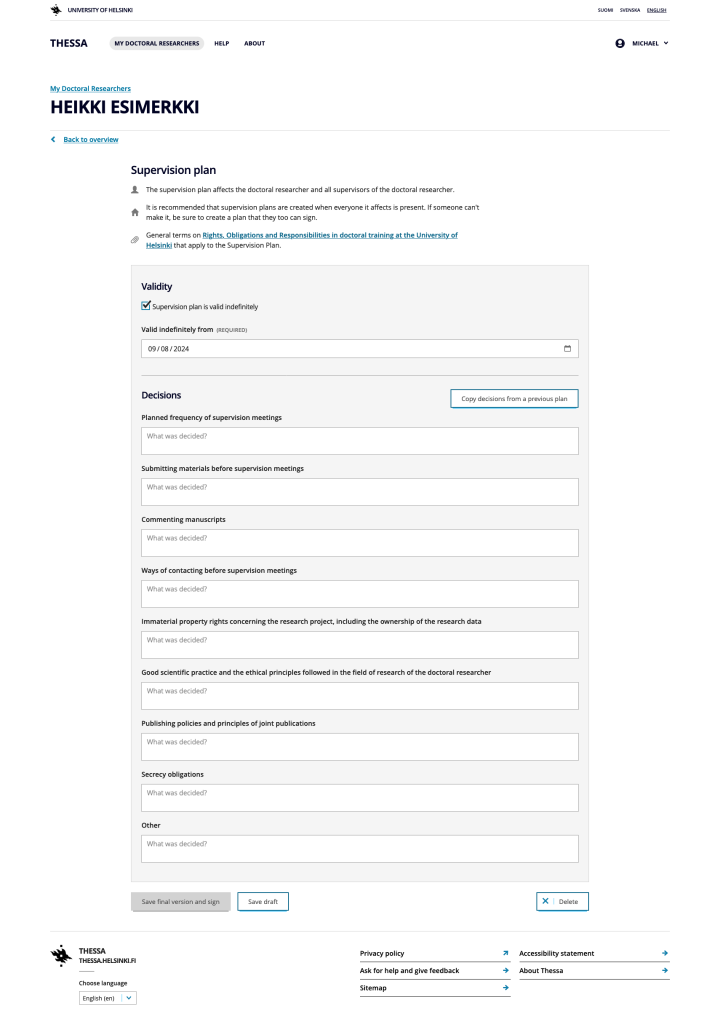
Supervision plans are drawn up jointly by doctoral researchers and their supervisors. Their purpose is to clarify the practices, responsibilities and expectations associated with supervision, as well as to support the systematic progress of doctoral thesis work. 

The primary supervisor completes the supervision plan in their Thessa view together with the doctoral researcher and possible other supervisors. Once the plan contains the required content, it will be transferred to the doctoral researcher and other supervisors for approval. All parties must approve the plan for it to become valid. 

By default, supervision plans are valid indefinitely, but they can be updated as the work progresses.

A model supervision plan

My PhD project

The My PhD project section is for doctoral researchers to plan the stages of their doctoral thesis work and studies as well as update their progress. 

The section is divided into the following parts: publications, conferences and mobility, funding, courses, teaching, and attachments. Doctoral researchers record the relevant details in Thessa, making them available to supervisors and thesis committee members.

Doctoral researchers who have started their studies on or after 1 January 2026 and doctoral researchers in the doctoral education pilot use the redesigned Thessa view.

In the redesigned Thessa view, the My PhD project section includes two new parts:

  • Chapters 
  • Thesis committee

Chapters

In Thessa, the progress of doctoral thesis work can be planned during the time between thesis committee meetings, known as chapters. Using these chapters is voluntary, but they can make it easier to divide the work into stages, set interim goals and monitor progress. For example, for each chapter, you can record three to five key goals for the doctoral thesis work.

Thesis committee

Doctoral researchers add their thesis committee meeting dates to their thesis committee section.

Reports

Annual reports support thesis committee meetings, helping to draw together the progress of the work, central achievements, potential challenges and subsequent goals. They also serve as a reminder for convening the thesis committee. 

Reports must be drawn up at least once a year roughly one to two weeks before the thesis committee meeting to give the members enough time to read them and keep the information as current as possible.

Reports present an overview of the current status of doctoral thesis work. Most of their content is automatically obtained from the details recorded in the My PhD project section. In addition, doctoral researchers assess the time spent on their doctoral theses and their current status, also describing the key achievements and challenges of the past year. Reports can include attachments (such as an updated research plan), but they are not necessary unless specifically requested.

Report creation

Reports can be found at the bottom of Thessa’s main page. Start creating a report by clicking ‘Create report’.

Once doctoral researchers have submitted their reports in Thessa, the supervisors and thesis committee members can immediately review them. Doctoral researchers can familiarise themselves with the detailed thesis committee guidelines of their doctoral programme in the Studies Service.

The report section includes a discussion bar where all parties can comment on the report content and propose changes or improvements. Doctoral researchers will also receive these comments by email and can edit their reports as needed.

Closing the report

At the end of reporting, doctoral researchers write the conclusions and recommendations section of the report together with the thesis committee members. This section records key matters discussed in the meeting, the progress of the doctoral thesis work and any agreed next steps. The conclusions and recommendations are written together with the thesis committee members at the end of the meeting. The recording method depends on the Thessa view in use.

Doctoral researchers who have begun their studies before 1 January 2026

At the end of thesis committee meetings, doctoral researchers write the conclusions and recommendations section of the report with the thesis committee members present. Doing so will close the report, which is necessary to be able to create the next report. The conclusions and recommendations will be automatically emailed to the thesis committee members and supervisors. After this, the conclusions and recommendations can no longer be edited. 

Doctoral researchers who have begun their studies on or after 1 January 2026, doctoral researchers in the doctoral education pilot

This group uses the redesigned Thessa view, where meetings are organised in the Thesis committee section. Meeting dates must be recorded in Thessa in advance. After completing the annual report, the meeting can be started by clicking the link next to the meeting date. 

The link opens a meeting view where the proposed agenda is available as support. Doctoral researchers take meeting minutes in the meeting view.

The reporting period will not close until the meeting is permanently concluded. After this, the thesis committee meeting will be displayed as held in Thessa. NB! Conclude the meeting permanently only after all details have been carefully checked. The reports of permanently concluded meetings can no longer be edited.
More information and support

Thessa is continuously updated, and minor changes are therefore made from time to time. The instructions are updated to reflect the latest changes as soon as possible after the updates.

Thessa’s Help section provides support for using the system.

HelsinkiUni Help provides support related to Thessa’s content and its technical aspects.

You can also give feedback on Thessa through HelsinkiUni Help to promote its continuous development.