Interested in sustainability themes and internationality? Try out a virtual exchange!
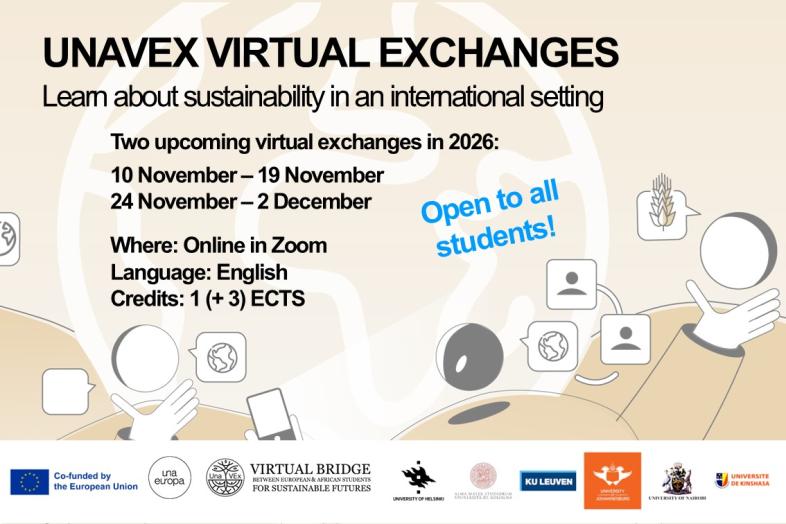
Two Una Europa Virtual Exchanges for Sustainability (UnaVEx) virtual exchanges are taking place this autumn. In the UnaVEx virtual exchanges students get to explore sustainability topics in an international learning environment.
The virtual exchanges are online courses that gather students from across Europe and Africa – with your fellow students you will learn about sustainability challenges from the perspectives of diverse cultures and environments.
The virtual exchanges are open and free of charge to all students. No prior studies in sustainable development or the natural sciences are required. The course language is English, and the course scope is one credit.
The upcoming virtual exchanges are organised:
- November 10 – November 19, 2026 - UnaVEx virtual exchange 4
- November 24 – December 2, 2026 - UnaVEx virtual exchange 5
The virtual exchanges take place online on five days, three hours per day. On the course you will work together with fellow students on a sustainability action, which all members of your group will get to implement in their own local context. Note that you can only participate in one of the two virtual exchanges organised. You can see the exact course times and find the registration form on the UnaVEx website.
As part of the course, participants should preferably complete the three-credit MOOC Introduction to Sustainability through independent study. UnaVEx virtual exchange is a great way of exploring sustainability issues from multiple viewpoints. After the UnaVEx virtual exchange the participants can continue to expand their knowledge, for example, with the Climate University’s other online courses.
The UnaVEx virtual exchanges are organised by the University of Helsinki, the University of Bologna (Italy), KU Leuven (Belgium), the University of Johannesburg (South Africa), the University of Nairobi (Kenia) and the University of Kinshasa (Democratic Republic of Congo). The exchange initiative is part of the EU-funded UnaVEx project.