Information for Curriculum 2026-2030
Curriculum 2026-2030
ECGS schedule 2026-2030
The Master's programme in Environmental Change and Global Sustainability offers three different degree titles: Master of Science, Master of Science (Agriculture and Forestry) and Master of Social Sciences. The degree title is determined by the student’s choice of disciplinary study module in their study plan. If the chosen module has two possible degree titles, the suitability of the chosen degree title is evaluated in relation to the study plan’s content and may also be assessed based on the potential thesis topic area.
The corresponding degree titles for each study module are:
Environmental Change:
- Urban socio-ecological interactions & governance, Master’s degree in Science (M.Sc.)
- Changing Arctic and Northern Environments, Master’s degree in Science (M.Sc.)
- Aquatic Sciences, Master’s degree in Science (M.Sc.)
- Sustainability of Agriculture and Food Systems, Master’s degree in Science (Agriculture and Forestry)
Global Sustainability:
- Policy, politics and everyday practices in local environments, Master’s degree in Social Sciences (M.Soc.Sc.)
- International environmental governance, Master’s degree in Science (M.Sc.) or a Master’s degree in Science (Agriculture and Forestry)
- Just and sustainable forest and land governance, Master’s degree in Science (Agriculture and Forestry)
- Diversity and Justice for Sustainability, Master’s degree in Social Sciences (M.Soc.Sc.) or a Master’s degree in Science (Agriculture and Forestry)
Note: A change of study module results in a corresponding change to the degree title. The final degree title will be determined after submission of the graduation request, based on the completed study module.
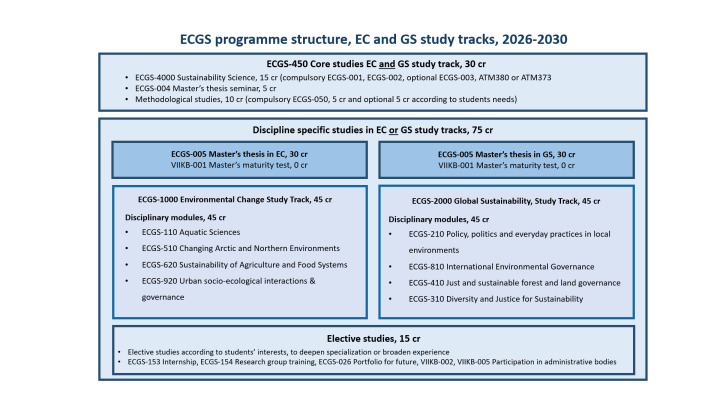
In the ECGS programme structure, studies are divided into three sections:
- Core studies 30 credits
- Discipline-specific studies 75 credits
- Elective studies 15 credits
Core studies consist of Sustainability Science module (15 cr), Methodology studies (10 cr) and the Master's thesis seminar (5 cr).
Discipline-specific studies consist of one disciplinary module (45 cr) and the master's thesis (30 cr). The disciplinary modules are chosen according to study track, which is already determined as a part of the application process. The two possible study tracks are Environmental Change (EC) or Global Sustainability (GS).
Elective studies may include for example; studies within the ECGS, studies from other Helsinki University programmes , studies in another University (JOO-studies) or exchange studies.
Teaching language in the programme is mostly English. However, all assignments, exams and dissertations can be done in English, as well as in Finnish and Swedish.
For more detailed information about the ECGS programme's modules and courses, see programme's Moodle site: ECGS Info site 2026-2030
Information for Curriculum 2023-2026
Curriculum 2023-2026
The Master's programme in Environmental Change and Global Sustainability offers three different degree titles: Master of Science, Master of Science (Agriculture and Forestry) and Master of Social Sciences. The degree title is determined by the study track and the discipline module completed in it, and in unclear cases, the topic of the master’s thesis and its supervisor.
In the Environmental change study track, the choice of Soil Science or Agricultural and Environmental Science modules leads to the title Master of Science (Agriculture and Forestry), the others lead to the title Master of Science .
In the Global sustainability track, the completion of the Forestry module leads to the Master of Science (Agriculture and Forestry) degree title, the Environmental Policy and Economics either to the Master of Science (Agriculture and Forestry), or Master of Social Sciences degree title, other modules in the track lead to the Master of Social Sciences degree title.
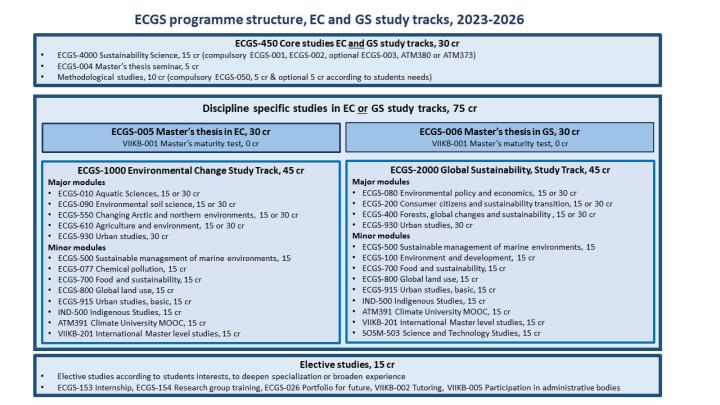
In the ECGS programme structure, studies are divided into three sections:
- Core studies 30 credits
- Discipline-specific studies according to study track 75 credits (including Master's thesis 30 cr)
- Elective studies 15 credits
Core studies consist of the Sustainability Science module (15 cr), Methodology studies (10 cr) and the Master's thesis seminar (5 cr).
Discipline-specific studies are chosen according to study track, which is already determined as a part of the application process. The two possible study tracks are; the Environmental Change track (EC) and the Global Sustainability track (GS).
- International students in EC will be awarded the degree Master of Sciences. However, if they choose the module in Environmental Soil Science or Agriculture and Environment as part of their advanced studies, they will be awarded the degree of Master of Science (Agriculture and Forestry) upon their graduation.
- International students in GS will be awarded the degree Master of Social Sciences. By choosing the module in Global Forestry Sustainability as part of their advanced studies, students will be awarded the degree of Master of Science (Agriculture and Forestry) upon graduation.
Students may choose one Major module of 30 credits, or two of them with 15 cr scope. In addition, one Minor module of 15 cr or one Major module of 15 cr is to be chosen.
Elective studies may include for example; studies within the ECGS, studies from other Helsinki University programmes , studies in another University (JOO-studies) or exchange studies.
Teaching language in the programme is mostly English. However, all assignments, exams and dissertations can be done in English, as well as in Finnish and Swedish.
For more detailed information about the ECGS programme's modules and courses, see programme's Moodle site: ECGS Info site 2023
Information for Curriculum 2020-2023
Curriculum 2020-2023