Scope and structure of the degree

Belongs to themes:

By selecting a degree programme you are able to see the general content as well as the possible degree programme-specific content. You do not have to select a degree programme to see the Open University's instructions.

University students complete a first-cycle higher education degree (Bachelor’s) before completing a second-cycle higher education degree (Master’s). Master’s degree holders may apply for doctoral studies.

On this page, you will find general information on the structure of undergraduate degrees, or first- and second-cycle higher education degrees, at the University of Helsinki, as well as information specific to your degree programme.

Your own programme's full degree structure is available at the top of the page in the main menu of the Studies Service, under the heading Degree Structure

On this page

Scope of the degree

The scope of studies is expressed in credits. The number of credits obtainable from courses will be determined by the required workload. One credit corresponds to approximately 27 hours of work. The average input of 1,600 hours required for the completion of studies in one academic year corresponds to 60 credits (cr).

The scope of a first-cycle (bachelor’s) degrees is 180 credits, and that of a second-cycle (master’s) degrees is 120 credits. The University of Helsinki has limited the number of completed credits that the degree certificate will indicate. You can incorporate up to 200 credits into a 180-credit bachelor’s degree and up to 135 credits into a 120-credit master’s degree.

Exceptions:

  • Master of Arts (Psychology) degree: 150 cr
    • Completed after a bachelor’s degree
    • Your degree can incorporate up to 165 cr, but
    • If your degree includes pedagogical studies for teachers required for a subject teacher qualification, you can exceed the maximum scope of the degree.
  • Licentiate of Veterinary Medicine degree: 180 cr
    • Completed after a bachelor’s degree
    • You can incorporate up to 200 cr into your degree.
  • Licentiate of Medicine degree: 180 cr (study rights beginning on or after 1 August 2025)
    • Completed after a bachelor’s degree
    • You can incorporate up to 200 cr into your degree.
  • Licentiate of Dentistry degree: 150 cr (study rights beginning on or after 1 August 2025)
    • Completed after a bachelor’s degree
    • You can incorporate up to 165 cr into your degree.
  • Licentiate of Medicine degree: 360 cr (study rights that began on 1 August 2024 or before)
    • Completed as a single-cycle degree
    • You can incorporate up to 400 cr into your degree.
  • Licentiate of Dentistry degree: 330 cr (study rights that began on 1 August 2024 or before)
    • Completed as a single-cycle degree
    • You can incorporate up to 365 cr into your degree.

The above credit limits apply to students whose right to study commenced on or after 1 August 2017. If your right to study commenced before 1 August 2017, the number of credits to be incorporated into degrees may have been limited on a faculty-specific basis. Your right to study is considered to have commenced before 1 August 2017 if you were admitted through a transfer application procedure and your original right to study commenced before 1 August 2017.

What studies are included in my degree?

From the degree structure of your degree programme, you can see what studies you need to complete for your degree. You can view the degree structure as well as degree programme, study module and course details at the top of the page in the main menu of the Studies Service, under the heading Degree Structure. You will also see the information in Sisu after you have completed the study plan. You can view the entire curriculum of your degree programme on the Curriculum and equivalence between curricula page.

All Bachelor’s degrees completed at the University of Helsinki include:

  • a minimum of 60 credits of studies in the field of the degree programme: the minimum scope of basic studies is 25 credits and the minimum scope of basic and intermediate studies in total is 60 credits. Intermediate studies include a thesis (6 cr) and a maturity test.
  • a thesis seminar (applies to curricula as of 1 August 2026)
  • language and communication skills, minimum 10 credits
  • basic skills in ICT and knowledge management, minimum 3 credits
  • a career module and professional skills training modules, minimum 10 cr
  • a  study plan in Sisu
  • The Finnish Bachelor’s Graduate Survey (kandipalaute.fi)
  • University’s student feedback survey
  • optional studies offered by the degree programme or by other degree programmes.

All Master’s degrees completed at the University of Helsinki include:

  • advanced studies in the field of the degree programme (min. 60 credits) including a thesis (30 credits) and maturity test. Exception: for medicine, dentistry, and veterinary medicine, the scope of the thesis is 20 credits
  • other studies offered by the student’s degree programme or other degree programmes to meet the minimum scope of the degree
  • If the scope of the thesis is 30 credits, the curriculum includes a 5-credit or a 10-credit thesis seminar (applies to curricula as of 1 August 2026).
  • a study plan in Sisu
  • University’s student feedback survey

Degrees also include career orientation and expert identity studies and career planning.

Information Specific to Your Degree Programme

These instructions are available only in Finnish/Swedish. For more information, please change the language of this page to Finnish/Swedish.

Information Specific to Your Degree Programme

Nordic Master Programme in Environmental Changes at Higher Latitudes (EnCHiL)

Students who started their studies in Helsinki in the autumn 2024 and 2025:

Your degree will include:

  • 76 credits of compulsory common courses (Master's thesis + other courses)
  • 24 - 44 credits of other advanced level courses
  • 0 - 20 credits of other studies

In more detail:

76 credits of compulsory courses include:

  • 30 cr Master’s thesis
  • 0 cr Maturity test (will be included in the thesis work)
  • 30 cr Icelandic spring courses
  • 1 cr Graduate student seminars II
  • 5 cr Statistical Tools for Climate and Atmospheric Sciences

Two out of these

  • 5 cr Living with Changing Climate
  • 5 cr Climate.now
  • 5 cr  IN&E issues at the Arctic edge - Environmental Issue in Iceland [distance learning] organized by AUI
     

Other advanced level courses 24 – 44 credits: Select from the listed elective courses. Other courses need to be approved by Katja Lauri.

Other studies: These studies can be also bachelor’s level courses. If they are not prerequisite courses of compulsory or elective master’s level courses, they need to be approved by the Education Coordinator.

Please note: Language courses are recommendable, but cannot be included in the degree.


Information Specific to Your Degree Programme

Master’s Programme in Global Governance Law

Please note that the programme is designed to be completed in two years on a full-time basis, and comprises a lot of teaching where attendance is mandatory. All courses are taught once per academic year.

Year 1 (60 ECTS)

The first year of the degree consists of compulsory courses. You can find a list of courses further down this page.

The first semester provides you with theoretical knowledge of global governance and basic knowledge of relevant key fields of law. You are introduced to various aspects of global governance law, starting from its historical and theoretical aspects, and then moving to the broader legal framework consisting of public international law, European Union law, global administrative law and advanced human rights law. You attend interactive lectures that are supported by small-group tutorials led by post-doctoral researchers and doctoral researchers. The latter consist of assignments and readings with ample opportunity for discussion.

The second semester will deepen your understanding of global governance law through group work and essay writing. You will examine international institutions, decision-making and governance in the EU, and governance in various specific fields including economic and financial governance, environmental governance, private global governance and security and transnational crime governance.

All first-year courses are compulsory.

Year 2 (60 ECTS)

The second year involves the compulsory Master’s thesis seminar. It consists of a research seminar essay and research seminar (5 ECTS), an introductory legal thinking and methodology course (5 ECTS) as well as completing the Master's thesis (30 ECTS).

During this one-year-long project, you participate in seminar meetings, complete seminar assignments, write your Master’s thesis and present your findings in research seminar meetings. You get regular feedback about your work from your supervisor and fellow students. Upon completing the seminar, you will have advanced academic argumentation and writing skills as well as a thorough understanding of your thesis topic.

In addition, you take 20 optional credits, which you can choose from the GGL programme, other Faculty of Law programmes, courses from the Global Politics and Communication Master’s Programme, studies completed on student exchange, language courses offered by the University Language Centre, and/or an internship.


DEGREE STRUCTURE AND COURSE LISTING 2025-2026

Master’s Programme in Global Governance Law (120 cr​edits)
 

First year (60 ECTS)​ - Compulsory Studies

Autumn semester: Introducing the framework of global governance law​

  • GGL-312 Introduction to GGL Studies – during orientation week​ (5 ECTS) - 25.8.-29.8.2025
  • GGL-301 Introduction to Global Governance Law: History and Theory (5 ECTS) - 26.8.–25.9.2025
  • GGL-302 Principles of International Law (5 ECTS) - 8.9.–31.10.2025
  • GGL-303 Public European Law (5 ECTS) - 29.9.–20.10.2025
  • GGL-304 Global Governance and Global Administrative Law (5 ECTS)​ - 29.10.–20.11.2025
  • GGL-306 The Law of International Organizations (5 ECTS) - 18.11.-11.12.2025

Spring semester: Deepening understanding of global governance ​law​

  • GGL-307 Decision-making & governance in the EU (5 ECTS)  - 12.1.–25.2.2026
  • GGL-313 International Human Rights Law (5 ECTS) - 13.1.–13.2.2026
  • GGL-310 Private Global Governance (5 ECTS) - 2.2.–27.2.2026
  • GGL-311 Security, Privacy and Human Rights Law (5 ECTS) - 13.4.–5.5.2026
  • GGL-314 International Environmental Law - 9.3.–26.3.2026
  • GGL-308 Principles of financial regulation (5 ECTS) - 17.3.–30.4.2026 


Second year (60 ECTS)​ - Master's Thesis and Optional Studies

Master's Thesis seminar:​

  • GGL-350 Research seminar (5 ECTS) - 19.9.2025–28.4.2026
  • GGL-360 Methodologies in Law and Legal Studies Seminar (5 ECTS) - 3.9.–23.10.2025
  • GGL-800 Master's thesis (30 ECTS) - Register in Sisu for the semester you hand in your thesis!
  • GGL-801 Maturity test (0 ECTS) - Register in Sisu for the semester you hand in your thesis!
     

20 credits of optional studies:

1) Offered under the GGL-programme

  • GGL-410/GGL-411 Rule of Law and Human Rights in Authoritarian Governance - 13.10.-5.11.2025
     

2) Studies from the Master's Programme in Global Politics and Communication available to GGL-students

  • GPC-E311 Historical development of economic theories in context (5 cr), responsible teacher: Monique Taylor
  • GPC-E312 Explaining the scope for differences in global political economy (5 cr), responsible teacher: Monique Taylor
  • GPC-E313 Modern money theory and the revival of classical political economy (10 cr), responsible teacher: Heikki Patomäki
  • GPC-E511 Inequalities, growth and capital in the 21st century (5 cr), responsible teacher: Sonja Amadae
  • GPC-E315 Governance of the world economy and its future (5 cr), responsible teacher: Heikki Patomäki
  • GPC-O314 Information society policy and governance (5 cr), responsible teacher: Johanna Jääsaari
  • GPC-O315 Organizational Communication in the Digital Age (5 cr), responsible teacher Pekka Sauri
  • GPC-O319 Global Climate Governance, Policy Networks and the Politics of Evidence (5 cr), responsible teacher: Tuomas Ylä-Anttila
  • GPC-O317 Digital Politics and Policy (5 cr), responsible teacher: Tuomas Ylä-Anttila/ Daria Gritsenko
  • GPC-O318 Politics of Migration (5 cr), responsible teacher: Tero Erkkilä/Meng-Hsuan Chou
  • GPC-M311 Populism, Polarization and the Media (5 cr), responsible teacher: Emilia Palonen
  • GPC-M322 Media, Activism and Social Change (5 cr), responsible teacher: Mervi Pantti
  • GPC-M323 New Forms of Mediated Participation (5 cr), responsible teacher: Johanna Sumiala
  • GPC-M324 Media and Globalization (5 cr), responsible teacher: Kari Karppinen 


Students can combine studies listed above with optional courses from other Faculty of Law programmes, studies completed on student exchange, language courses offered by the University Language Centre, and/or an internship.​ 

Please note the following courses (or corresponding older courses with other course codes) cannot be included in the GGL-degree: 

  • SON-100 Introduction to jurisprudence and legal thinking 1 (2 cr)
  • AYOIK-101 Open uni: Introduction to Jurisprudence (5 cr)

If you have questions regarding the degree structure, please contact programme admin coordinator Anna Käyhkö.

Information Specific to Your Degree Programme

These instructions are only available in Finnish. If you have questions, please contact siltavuori-student@helsinki.fi

Information Specific to Your Degree Programme

These instructions are only available in Finnish. To see the content in Finnish, please change the language at the top of the page.

Information Specific to Your Degree Programme

These instructions are available only in Finnish. For more information, please change the language of this page to Finnish.

Faculty of Pharmacy

Instructions about degree structure are only in Finnish. You can see them by changing language at the top of this page.

Information Specific to Your Degree Programme

These instructions are available only in Finnish. For more information, please change the language of this page to Finnish.

Information Specific to Your Degree Programme

All students in the Bachelor's programme in Geosciences study Basic studies (25 cp) and Intermediate studies (50-55 cp) in Geoscience.

In the 2023-26 degree programme the studies of other disciplines are the same for all the students, min of 10 cp Chemistry and 5 cp Physics on top of the methods module 10 cp.

In the 2020-23 degree programme the studies of other disciplines are the same for all the students, min of 10 cp Chemistry and 5 cp Physics on top of the methods module 10 cp. Students studying according to the 2020-2023 degree requirements must graduate by July 31st 2026.

The degree structure in more detail here: 2020-23, 2023-26 below on this page.

Options to continue in MSc programmes

As a student of BSc Programme in Geosciences you have an automatic option to several Master's programmes which one of them is the Master´s Programme in Geology and Geophysics. More information on course requirements can be found in the chapter Right to complete a Master's degree


Information Specific to Your Degree Programme

This information is not available in English. Please change the language of the page to Finnish for more information.

Restrictions on study modules in your degree

Restricted language study module combinations

You can only include one Language Centre language study module in your degree. You may not include a Language Centre language study module in the same language in any language study track.

See further information on language study modules.

Other restricted study module combinations

You may not include in one degree:

  • study modules in Finnish language and Finnish Language and Culture,
  • study modules in Scandinavian languages and nordiska språk, or
  • study modules in Scandinavian languages (Swedish as second domestic language) and Scandinavian languages (Swedish as the first language).

Information Specific to Your Degree Programme

These instructions are only available in Swedish. If you have questions, please contact siltavuori-student@helsinki.fi

Information Specific to Your Degree Programme

These instructions are only available in Swedish. If you have questions, please contact siltavuori-student@helsinki.fi

Information Specific to Your Degree Programme

These instructions are only available in Swedish. If you have questions, please contact siltavuori-student@helsinki.fi

Information Specific to Your Degree Programme

These instructions are available only in Swedish. For more information, please change the language of this page to Swedish.

Information Specific to Your Degree Programme

These instructions are only available in Finnish. If you have questions, please contact siltavuori-student@helsinki.fi.

Information Specific to Your Degree Programme

These instructions are only available in Finnish. If you have questions, please contact siltavuori-student@helsinki.fi

Information Specific to Your Degree Programme

These instructions are only available in Finnish. If you have questions, please contact siltavuori-student@helsinki.fi

Information Specific to Your Degree Programme

These instructions are available only in Finnish. For more information, please change the language of this page to Finnish.

Information Specific to Your Degree Programme

These instructions are only available in Finnish. If you have questions, please contact siltavuori-student@helsinki.fi

Information Specific to Your Degree Programme

These instructions are only available in Finnish. If you have questions, please contact siltavuori-student@helsinki.fi

Information Specific to Your Degree Programme

These instructions are only available in Finnish. If you have questions, please contact siltavuori-student@helsinki.fi

Information Specific to Your Degree Programme

This information is not available in English. Please change the language of the page to Finnish for more information.

Information Specific to Your Degree Programme

These instructions are available only in Finnish. For more information, please change the language of this page to Finnish.


Information Specific to Your Degree Programme

This information is not available in English. Please change the language of the page to Finnish for more information.


Information Specific to Your Degree Programme

These instructions are available only in Finnish. For more information, please change the language of this page to Finnish.

Information Specific to Your Degree Programme

This information is not available in English. Please change the language of the page to Finnish for more information.

Information Specific to Your Degree Programme

This information is not available in English. Please change the language of the page to Finnish for more information.

Information Specific to Your Degree Programme

This information is not available in English. Please change the language of the page to Finnish for more information.

Information Specific to Your Degree Programme

This information is not available in English. Please change the language of the page to Finnish for more information.

Information Specific to Your Degree Programme

The instructions for this page are only in Finnish. For more information, change the language of this page into Finnish.

Study track: Mathematics teacher

This information is not available in English. Please change the language of the page to Finnish for more information.

Study tracks

This information is not available in English. Please change the language of the page to Finnish for more information.

Study track: Physics teacher

This information is not available in English. Please change the language of the page to Finnish for more information.

Study track: Chemistry teacher

Second teaching subject

This information is not available in English. Please change the language of the page to Finnish for more information.

Information specific to forest sciences

These instructions are only in Finnish. You can see the instructions when you change the language of the page to Finnish.

Information Specific to Your Degree Programme

These instructions are available only in Finnish. For more information, please change the language of this page to Finnish.

Special characteristics of the degree programme

Branches of law taught at the Faculty are divided into thematic modules. Teaching is organised so that the disciplines taught under each thematic module constitute a coherent and appropriately aligned whole in terms of content and methods.

Teaching in each thematic module included in the Bachelor’s Programme in Law is organised in two strands by distributing the teaching as follows:

  • Introductory lecture of the thematic module
  • Weekly contact teaching based on advance preparation by the students (lectures)
  • Weekly small group exercises
  • In addition, teaching may include expert lectures.

The intention is to organise contact teaching and small group exercises by class at standardised teaching times so that contact teaching is organised at the beginning of the week and small group teaching towards the end of the week. Participation in small group teaching is compulsory. Thematic modules include course-specific interim examinations and a final examination on the whole module.

A predetermined part of course credits are linked with the final examination of the thematic module.

Check the Moodle platform for the basic studies.

Regulations related to the curricula of Bachelor of Laws and Master of Laws degrees include the following information:

  • Participation in teaching
  • Examinations (use of statute books)
  • Grading (updated grade boundaries)
  • Seminars
  • Master’s thesis

See also the degree structure in Sisu and curricula (in Finnish).


Information Specific to Your Degree Programme

Timetable model

Bachelor’s programme timetable model (in Finnish only)

Specification of study track from 1 August 2022

Study tracks

The programme features three study tracks: politics and organisations, world politics, and media and communication. During the first year of studies, all students complete the compulsory basic and intermediate studies in the programme. As a rule, students register for study tracks during their first year. This means that, at the beginning of the second year, they know the study track from which they will graduate at the end of their bachelor’s studies. Students can register for the procedure for specifying their study track only once during their bachelor’s studies.

The registration process takes place once a year, in May.

When and how to register for the procedure for the specification of the study track

Students can register after completing all the courses listed below.

Basic studies, 25 cr, and compulsory intermediate studies in the programme, 15 cr, total 40 cr:

  • PVK-P110 Introduction to Politics and Organisations, 5 cr
  • PVK-M120 Introduction to World Politics, 5 cr
  • PVK-V130 Introduction to Media and Communication, 5 cr
  • PVK-P140 Decision-making in Finland and the European Union, 5 cr
  • PVK-V160 Media and Culture, 5 cr
  • PVK-Y201 Publicity, Democracy and the Media, 5 cr
  • PVK-Y202 Globalisation and Global Governance, 5 cr
  • PVK-Y203 Foundations of Political Thought, 5 cr

How to determine the study track 

The method of determining the study track is based on either unrestricted registration or an application procedure, depending on the prospective study track.

1. Unrestricted registration

  • Study Track in Politics and Organisations
  • Study Track in Media and Communication

In the determination procedure, students can freely register for the study track in Politics and Organisations and the study track in Media and Communication. The only requirement for registration is that they have completed the required courses (40 cr) by the date indicated.

2. Application procedure

  • Study Track in World Politics

Students wishing to select the study track in World Politics must select it as their preferred option in the determination procedure and indicate either the study track in Media and Communication or the study track in Politics and Organisation as their second choice.

If a student is not admitted to the study track in World Politics, they will be admitted to their second choice. Each year, the students registered for the study track in World Politics account for 21% of all students (all study tracks in total).  

Criteria and technical determination of the study track
Students registered for the study track in World Politics are assessed on the basis of their academic performance, credits accumulated and number of terms as attending students:

  • Grades of required courses (weighted average). The studies whose average is calculated are listed above.
  • The accumulated credits included in the bachelor’s degree in proportion to the time already spent in pursuing the bachelor’s degree. This includes the credits for all courses which the student has completed after receiving the right to complete a bachelor’s degree.

Academic performance and credits accumulated are of equal weight (50% and  50%) in the determination of the study track. If students are ranked equally after the above criteria, the number of credits accumulated will be the decisive criterion. In the above situation, if all students cannot be admitted for resource-related reasons, the students will be ranked by drawing lots.

Please note

In the case of the listed courses, the procedure for determining study tracks will consider the courses included in the previous degree requirements as well as their grades in accordance with a table of equivalence. Tables of equivalence for 2020–2023 can be found on the Instructions for Students website. If necessary, you can also read the rules on the expiry of studies.

Spring 2026 timetable

To register for a study track: 2.-18.5.2026, please complete the form available at: electronic form (open in Finnish only from 2nd May). All studies completed no later than 18 May, 2026 will be considered. Students can also register before all their studies have been entered into student records. 

Only for those who register for study track in World Politics: Credits that have been completed in Sisu no later than 7 June, 2026 will be included in the total number of credits.

Information Specific to Your Degree Programme

This information is not available in English. Please change the language of the page to Finnish for more information.

Information Specific to Your Degree Programme

These instructions are available only in Finnish. For more information, please change the language of this page to Finnish.


Information Specific to Your Degree Programme

These instructions are available only in Finnish. For more information, please change the language of this page to Finnish.

Information Specific to Your Degree Programme

This information is not available in English. Please change the language of the page to Finnish for more information.

Information Specific to Your Degree Programme

This content is currently available only in Finnish. For more information, please see the Finnish-language version of this page.

Information Specific to Your Degree Programme

These instructions are available only in Finnish. For more information, please change the language of this page to Finnish.

Special characteristics on curricula and model schedules

These instructions are available only in Finnish. For more information, please change the language of this page to Finnish.

Information Specific to Your Degree Programme

Bachelor's programme timetable model (in Finnish only).

Specification of study track

Each year, 20-30% of the number of registered students is placed in each of the four study tracks, depending on the students' priorities and teaching resources.

Students can register after completing all the courses listed below (40 cr):

Basic studies (20 cr):

  • YK-111 Introduction to Society & Change I 5 cr
  • YK-112 Introduction to Society & Change II 5 cr
  • YK-113 Practikum of Society and Change  5 cr
  • YK-115 Project work 5 cr or YK-114 Gender and Society 5 cr

Intermediate studies 4 x 5 cr (20 cr) of the following

  • YK-211 Global economic change 5 cr
  • YK-212 Society and Social Relations 5 cr
  • YK-213 Global development/ Continuities and Discontinuities, Connections and Disconnections 5 cr
  • YK-214A Policy and use of history 5 cr / YK-214 International history 5 cr [220-23]
  • YK-215 Environment and politics 5 cr
  • YK-216 Generations, mobilities and inequalities 5 cr
  • YK-217 Modern state and civil society 5 cr
  • YK-218 Attitudes, ideologies and cosmologies [former Beliefs, attitudes and cosmologies of change] 5 cr

Students register for study tracks during their first year (or after completing the required courses) in May. Students can register for the procedure for specifying their study track only once during their bachelor’s studies.

How the study track is determined

When registering, students must place all study tracks in the programme in order of preference.

The following information is then verified for all students registered for the specification of their study track:

  • Grades for the above courses
  • Total number of credits earned for the studies to be included in a bachelor’s degree. This includes the credits for all courses which the student has completed after receiving the right to complete a bachelor’s degree. If students are equally ranked under the above criteria, the number of credits earned will be the decisive criterion. If the students still remain equally ranked, the decision will be made by drawing lots.

Please note

In the case of the listed courses, the procedure for specifying study tracks will consider the courses included in the previous degree requirements as well as their grades in accordance with a table of equivalence. You can find the table on the Instructions for students. If necessary, you can also read the rules for the expiry of studies.

Spring 2026 timetable

To register for a study track: 2.-18.5.2026, please complete the form available at: electronic form (open in Finnish only from 2nd May). All studies completed no later than 18 May, 2026 will be considered. Students can also register before all their studies have been entered into student records. 

Credits that have been completed in Sisu no later than 7 June, 2026 will be included in the total number of credits. 

Information Specific to Your Degree Programme

These instructions are available only in Finnish. For more information, please change the language of this page to Finnish.

Information Specific to Your Degree Programme

These instructions are available only in Finnish/Swedish. For more information, please change the language of this page to Finnish/Swedish.


Information Specific to particle physics and astrophysical sciences

Curriculum 2023 - 2026

The curriculum entered into force on 1.8.2023. If you have started your studies before 1.8.2023, you can switch to the new curriculum or complete your degree according to the 2020-2023 curriculum until 31 July 2026. This is a link to the 2020 - 2023 curriculum

You undertake studies for a total of 120 credits according to your personal study plan. Your degree will include minimum of 90 credits of advanced courses.

Advanced studies in the Study Track in Astrophysical Sciences include:
  • 35 credits of obligatory courses common to both study tracks (= seminar 5 cr + thesis 30 cr)
  • 10 – 15 credits of Astrophysical Sciences core package (complete at least 2 courses)
  • 40 – 45 credits of optional advanced studies

= in total of 90 credits of advanced studies

Advanced studies in the Study Track in Particle Physics and Cosmology include:
  • 35 credits of obligatory courses common to both study tracks (= seminar 5 cr + thesis 30 cr)
  • 5 – 10 credits of obligatory core courses (complete either PAP325 + PAP332 Particle Physics courses, 10 credits OR PAP326 Cosmology II, 5 credits)
  • 45 - 50 credits of optional advanced studies

= in total of 90 credits of advanced studies

The optional advanced studies can include whole course packages or individual courses related to your field of interest and as agreed in your personal study plan.

Model timetables in particle physics and cosmology study track:

Cosmology

Theoretical and Experimental Particle Physics in excel form

Experimental Particle Physics (pdf)

Instrumentation

Astrophysical Sciences study track: Courses recommended by the research groups

0-30 credits of other courses from your Master’s programme or other programmes

Other studies may include study modules or individual courses form other degree programmes to meet the minimum total number of credits required for your degree. Also practical training and language studies can be included.

Choosing  Your Study Track

The study track is selected during the first semester of studies. Should you need to change your study track during your studies, please find further information here.

Information Specific to Your Degree Programme

This information is not available in English. Please change the language of the page to Finnish for more information.

Information Specific to Your Degree Programme

The Data Science MSc degree consists of 120 credits divided into core courses, elective data science courses, and other courses.

Core courses in data science 35 credits

The core courses in the programme consist of 35 credits worth of key data science courses.

In addition, you must complete a Master’s Thesis in Data Science 30 credits, Personal study plan and other studies 0-35 credits

Specialization Studies in Data Science >20 credits

You must pick at least 20 credits of courses from the following data science specialization courses. These are divided thematically into 5 key areas of data science. Each of the courses is worth 5 credits, so you will need to take at least 4 courses from the list below.

The Master's programme courses are grouped into thematic modules of 15 credits or more, but courses can be freely taken from any modules:

Machine Learning and Algorithms
Statistical Data Science
Data Science Infrastructures
Computers and Cognition
Interdisciplinary Data Science


More detailed information can be found on the next section of the page: Structure of your degree programme

Information Specific to Master's Programme in Ecology and Evolutionary Biology

Structure of Studies

You undertake studies for a total of 120 credits according to your personal study plan.

Curriculum 2023-2026

The curriculum enters into force on 1.8.2023.

If you have started your studies before 1.8.2023, you can switch to the new curriculum or complete your degree according to the 2020-2023 curriculum until 31 July 2026.

  • 90 credits of advanced studies in ecology and evolutionary biology
    • Ecology, 5 credits
    • Evolutionary biology, 5 credits
    • Statistical methods in ecology, 5 credits
    • Quantitative Methods in Ecology and Evolutionary Biology, 5 credits
    • Master’s thesis courses 1 and 2, 5+5 credits
    • Master’s thesis, 30 credits
    • 30 credits of alternative studies chosen from ecology, evolutionary biology and conservation.
  • 30 credits of other optional studies. You can choose studies from:
    • Master’s Programme in Ecology and Evolutionary Biology
    • other relevant master's programmes
    • Language center
    • Biodiversity Education Network
    • career studies and extracurricular activities
    • complete the studies as part of a student exchange abroad

Curriculum 2020-2023

  • 90 credits of advanced studies
    • Ecology, 5 credits
    • Evolutionary biology, 10 credits
    • Statistical methods in ecology, 5 credits
    • Master’s degree seminar, 5 credits
    • Master’s thesis course, 5 credits
    • Master’s thesis, 30 credits
    • 30 credits of alternative other studies chosen from the Master's Programme in Ecology and Evolutionary Biology
  • 30 credits of optional other studies
    • Optional studies chosen from your own or or from other degree programmes.
    • Career planning or extracurricular activities can also be included in your personal study plan.

Biology teacher study track

If you are studying to qualify as a biology teacher, in your degree you will complete:

  • 60 credits of pedagogical studies
  • 60 credits of ecology and evolutionary biology

This applies only to Finnish or Swedish speaking students who have been accepted to pedagogical studies during their Bachelor’s studies.

Degree language

The Master's programme in Ecology and Evolutionary Biology is a multilingual master's programme. Teaching is in English, but you can study in Finnish, Swedish or English, depending on which language you choose. If your degree language is Finnish/Swedish, you can change your degree language to English by applying for a change of degree language during the first semester of your master's studies. Please note that you can only obtain a diploma in English if your degree language is English.

If you have been admitted to the programme through the international call and have proven your English language proficiency at the admission stage, your degree language will automatically be English.

For more information on changing your degree language and the requirements for an English-language degree, see the page Languages of study and degrees.

Information Specific to Your Degree Programme

These instructions are available only in Finnish. For more information, please change the language of this page to Finnish.

Information Specific to Your Degree Programme

Structure of the degree from 1.8.2023 on

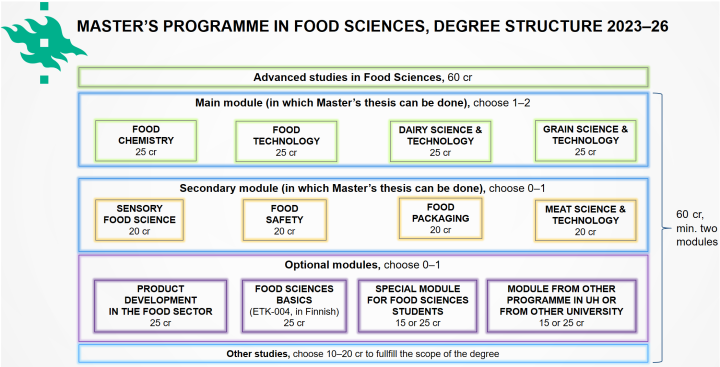
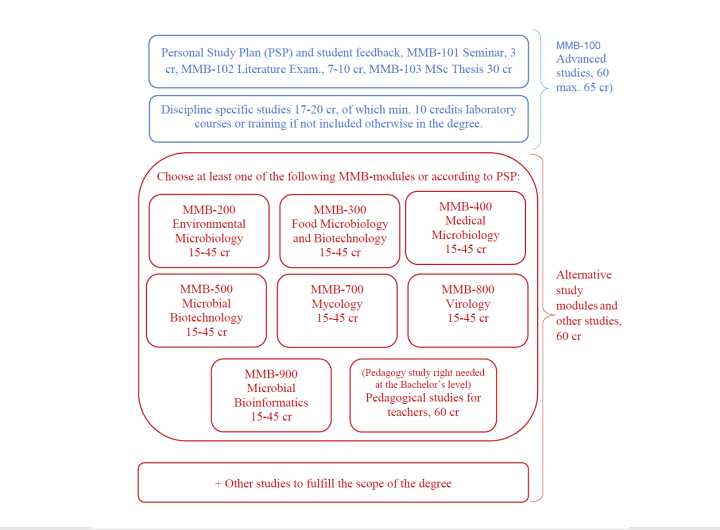
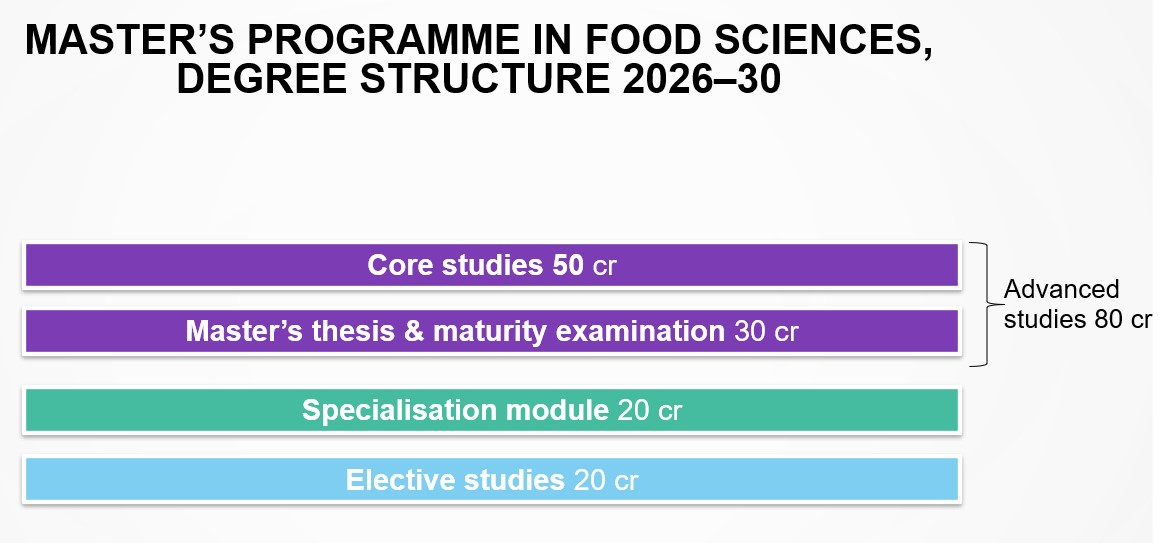
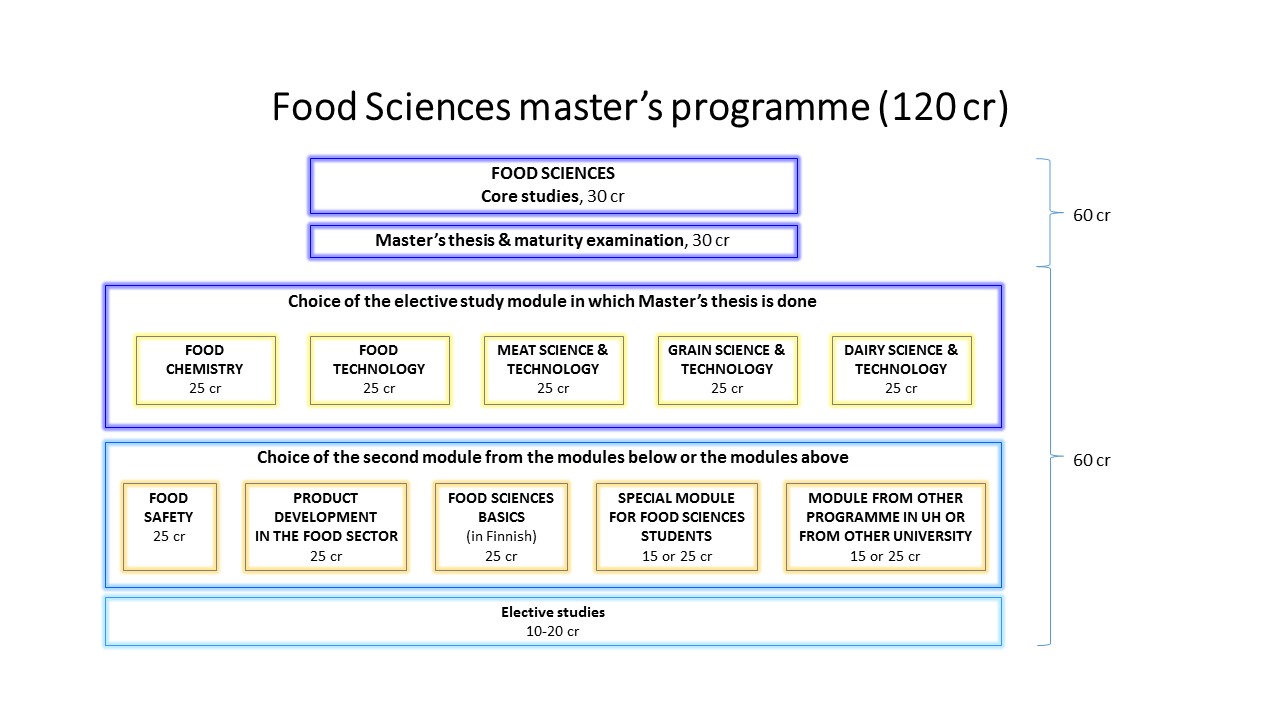
60 credits of advanced studies, 60 credits of studies of which at least one FOOD-module.


Structure of the degree in 2020-23

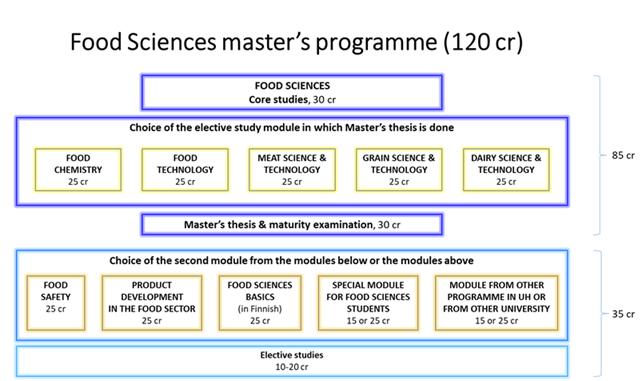
FOOD 2020-23 structure chart


See the curriculum 2023-2026 on the Curricula and equivalence between curricula page.

Content of the modules and course descriptions can be uploaded here as pdf file for 2020-23.

Structure of the Food Sciences master's program 2017-20.

Equivalence tables between old and new courses.

Information Specific to Your Degree Programme

This information is not available in English. Please change the language of the page to Finnish for more information.

Information Specific to Your Degree Programme

Structure of Studies

The degree consists of the following studies:

  • Advanced studies in the discipline (60–120 credits) and
  • If needed, you can take other courses to achieve the minimum credit requirement for the degree (a total of 120 credits).

Depending on your interests, you can also include elective subjects and other supporting studies.

During your Master’s studies, you will focus mainly on your specialisation, deepening your knowledge through coursework and writing your Master’s thesis.


To help you complete your studies, you will be assigned a personal advisor who will help you prepare a personal study plan at the beginning of your Master’s studies. 

The personal advisors for the academic year 2023-4 in the English Studies MA programme are:


Niina Hynninen

Minna Nevala

Merja Polvinen

Howard Sklar (on leave academic years 2023-25)

Carla Suhr (on research leave spring 2024)


You can also reach the study advisors by email: eng-hops@helsinki.fi.


NB! Please note that if you are a Finnish student who has taken a Finnish matriculation examination, then you will need to do Swedish (virkamiesruotsi) as a compulsory part of your MA degree. You can read more here.

Information Specific to Your Degree Programme

There are two study tracks in ENS programme (Humanities track and Social Sciences track) which are divided into advanced studies (100 cr) and other studies (20 cr). Below you can find the degree structure according to the curriculum 2023–2026. Detailed information about the structure, course contents and teaching arranged each academic year is available in Sisu.

Advanced studies (100 cr)

Joint Studies (20 cr)
  • ENS-301 Current Research on Europe and Norden, 5 cr
  • ENS-303 Common Challenges in Contemporary Europe, 5 cr
  • ENS-305 Nordic Societies and Cultures, 5 cr
  • ENS-309 Politics of the European Union, 5 cr
Research methods (10 cr)                              
Master's Thesis Seminar (10 cr) Master's Thesis (30 cr) and Maturity Test (0 cr)                           
  • ENS-350 Master's Thesis Seminar in European and Nordic Studies, 10 cr
  • ENS-800 Master’s Thesis in European and Nordic Studies, 30 cr
  • VALT-310M Maturity test (other language)
Track Specific Thematic Studies (30 cr)

Students complete at least one thematic study module (min. 15 cr) from their own study track.

Humanities track
Thematic Modules (15–30 cr)                            
  • Thematic Module 1: Nordic Studies        
  • Thematic Module 2: East Central European, Southeast European and Baltic Studies (ESEB)
  • Thematic Module 3: European Legal History and Traditions                      
Social Sciences track
Thematic Modules (15–30 cr)
  • Thematic Module 4: History and Memory in Europe                                   
  • Thematic Module 5: Politics and Communication                                         
  • Thematic Module 6: EU Studies
  • Thematic Module 7: Migration and Minorities                                                       

Optional European and Nordic Studies for both tracks (0–15 cr)

Other Studies (20 cr)

Career Skills (5–15 cr)
Elective studies

(Additional studies to reach the required 120 cr)

More detailed information on the curricula 2020–2023 and 2023-2026 is available in Sisu.

Information Specific to Your Degree Programme

Structure of Studies

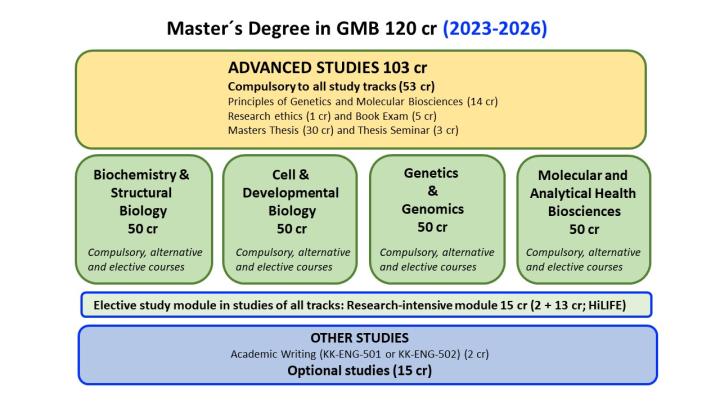
The structure of the programme (2023-2026)

A list of compulsory and optional courses in the GMB programme curriculum 2023-2026 (pdf)

Picture of the structure of the GMB degree in curriculum 2023-2026

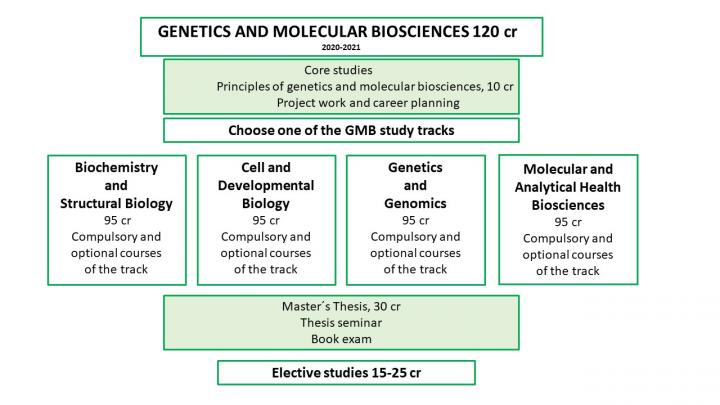
The structure of the programme (2020-2023)

A list of compulsory and optional courses in the GMB programme curriculum 2020-2023 (pdf)

GMB structure 2020


The structure of the programme (2017-2020)

Curriculum 2017-2020 can be found in the link (pdf).

Choosing Your Study Track

You will select your study track after the course Principles in Genetics and Molecular Biosciences (GMB-015) after the first period of the first year. You can specialise according to your interests in:

Information Specific to Your Degree Programme

There are three study tracks in the GPC programme (Global Political Economy (GPE), Governance, Organizations and Communication (GOC) and Media and Democracy (MD)), which are divided into advanced studies (90 cr) and other studies (30 cr). Below you can find the structure. Detailed information about course contents and teaching arranged each academic year is available in Sisu.

Degree structure (pdf)


Advanced studies (90 cr):


Joint studies 20 cr

  • GPC-311 Globalizations: Politics, Economy and Communication (5cr)
  • GPC-312 Theories of Politics and Communication in the Information Age (5 cr)
  • Methodology courses (10 cr)


Study Track Specific Studies 30 cr

Global Political Economy study track (GPE)

Compulsory courses 30 cr:

  • GPC-E314 Historical development of economic theories in context (5 cr)
  • GPC-E312 Explaining the scope for differences in global political economy (5 cr)
  • GPC-E313 Modern money theory and the revival of classical political economy (10 cr)
  • GPC-E511 Inequalities, growth and capital in the 21st century (5 cr)
  • GPC-E315 Governance of the world economy and its future (5 cr)


Governance, Organizations and Communication study track (GOC)

Compulsory courses 10 cr:

  • GPC-O316 Introduction to Governance, Organizations, and Communication (5 cr)
  • GPC-O312 Global Governance of Knowledge (5 cr)

Track-specific electives (20 cr)


Media and Democracy study track (MD)

Compulsory courses 10 cr:

  • GPC-M321 Advances in Democratic Theory and Research (5 cr)
  • GPC-M326 Media and Modernity: Global Perspectives (5 cr)

Track specific electives (20 cr)


Master’s Thesis Seminars for each study track 10cr + Master's Thesis 30 cr


Other studies (30 cr):

Career Skills 5-15 cr

Elective Studies 15-25cr

Language studies: Academic English courses (recommended)

Global Governance Law -courses (recommended)


Additional studies to reach the required 120 cr.

More detailed information on the curricula 2020-2023 and 2023-2026 is available in Sisu - tool for planning your studies.

Information Specific to Your Degree Programme

This information is not available in English. Please change the language of the page to Finnish for more information.

Information Specific to Your Degree Programme

Curriculum 2023 - 2026

The curriculum entered into force on 1.8.2023. If you have started your studies before 1.8.2023, you can switch to the new curriculum or complete your degree according to the 2020-2023 curriculum until 31 July 2026. This is a link to the 2020 - 2023 curriculum.

Your degree will include minimum of 120 credits out of which 95-120 credits are of advanced courses. The amount of compulsory and alternative advanced studies is different with each study track:

Meteorology

95 - 100 credits of advanced studies

  • 45 - 50 credits of compulsory advanced studies common to all study tracks (with some alternative options to choose from)
  • 50 credits of two compulsory course packages

Model timetables for obligatory courses in Meteorology (one table for students who have already completed basic studies in Meteorology and another for students with no prior studies in Meteorology)

Aerosol Physics

95 - 100 credits of advanced studies:

  • 45 - 50 credits of compulsory advanced studies common to all study tracks (with some alternative options to choose from)
  • 5 credits of compulsory aerosol physics course (= Aerosol physics II, ATM304)
  • 5 credits of optional data science course
  • min 20 credits of optional advanced studies courses of the study track
  • max 30 credits of optional adcanced studies common to all study tracks
Biosphere-atmosphere cycles

95 - 100 credits of advanced studies:

  • 45 - 50 credits of compulsory advanced studies common to all study tracks (with some alternative options to choose from)
  • min 20 credits of optional advanced studies courses of the study track
  • max 30 credits of optional advanced studies common to all study tracks
Geophysics of the Hydrosphere

95 - 100 credits of advanced studies:

  • 45 - 50 credits of compulsory advanced studies common to all study tracks (with some alternative options to choose from)
  • 20 credits of obligatory advanced core studies courses of the study track (ATM334, ATM335, ATM333, ATM310)
  • 25 credits of optional course package courses of which at least 15 credits from one and the same package
  • 0 - 5 credits of other advanced level studies until the total sum is 95-100 credits (for example, ECGS-011, ME-204, ME-203, MAST32005 or some other suitable course)
Atmospheric Chemistry and Analysis

95 - 100 credits of advanced studies

  • 45 - 50 credits of compulsory advanced studies common to all study tracks (with some alternative options to choose from)
  • 10 credits of compulsory study track studies (ATM306, KEM411)
  • 40 credits of optional advanced studies courses of the study track. (Also other KEM courses can be included in the advanced studies as agreed in Personal study plan with Academic mentor.)
Remote Sensing

95 - 100 credits of advanced studies

  • 45 - 50 credits of compulsory advanced studies common to all study tracks (with some alternative options to choose from)
  • 10 credits of compulsory course package (two courses of these three: ATM3, ME-204, MAST352005)
  • 40 credits of optional advanced studies course package studies of the study track
 
Other Studies

In addition to the abovementioned advanced studies, your degree will include 0-25 credits of other courses from your Master’s programme or other programmes.

Other studies may include study modules or individual courses form other degree programmes to meet the minimum total number of credits required for your degree. Also practical training and language studies can be included.

Choosing Your Study Track

Study track is selected during the first semester of studies.

Please notice that there are prerequisites to the study tracks in Aerosol Physics, Meteorology and Geophysics of the Hydrosphere that you need complete and include to your Master's degree if they (or equivalent knowledge) aren't included in your earlier degree. 

You can change the study track at any time of studies in the programme. More info on changing your study track can be found here

Meteorologist Qualification

Students graduating from the line of meteorology will be qualified to use the title of Meteorologist (in Finnish: Meteorologi), as defined in government decree 1039/2013.

Information Specific to Your Degree Programme

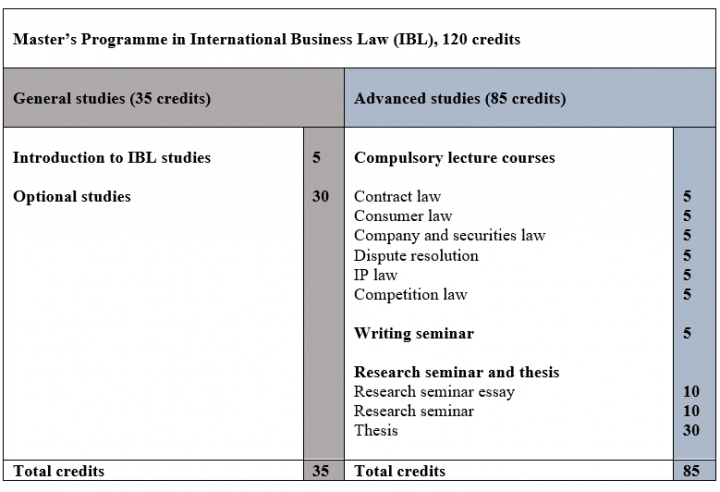
IBL programme structure diagram

The scope of the programme is 120 credits to be completed in two academic years, or 30 credits per semester.

The Compulsory lecture courses (30 credits) are completed during first year, and Research seminar and thesis (50 credits) are completed during second year. In addition, one writing seminar (5 credits) is compulsory, and can be completed during first or second year. If you complete more than one writing seminar, you can include the other writing seminar(s) in your 30 credits of optional studies.

As the majority of compulsory courses are completed in the autumn of first year, you will take most of your optional courses in the spring semester of first year. In your second year, you will focus on the research seminar and thesis, and you'll also take some more optional courses.
 

International Business Law, 120 credits, AY 2025-2026

General studies, 5 credits, compulsory
  • IBL-301 Introduction to IBL studies, 5 credits (not offered in autumn 2025)   
     
IBL-300 Advanced Studies in International Business Law, 85 credits
 

First-year courses (all compulsory)

Autumn semester:               

  • IBL-311 Competition and Market Law 5, credits
  • IBL-313 Contract Law, 5 credits
  • IBL-312 Consumer Law 5, credits                         
  • IBL-315 IP Law, 5 credits. Note: online exam only, no lectures. 

Spring semester:  

  • IBL-310 Company and Securities Law, 5 credits   
  • IBL-314 Dispute Resolution, 5 credits


Second-year courses (all compulsory)
 

  • IBL-320 IBL Research Seminar, 10 credits
  • IBL-321 IBL Research Seminar Essay, 10 credits
  • IBL-800 IBL Master's Thesis, 30 credits 
     

Writing Seminars (one is compulsory)

Spring semester: 

  • IBL-344 Writing seminar in law and artificial intelligence, 5 credits
     
Optional studies (30 credits compulsory)

 Spring semester:           

  • IBL-429 Multijurisdictional Corporate Compliance, 5 credits
  • IBL-449 Data Law, 5 credits
  • IBL-422 Introduction to European Health Law and Ethics, 5 credits 
  • IBL-443 Advanced Internal Market Law, 5 credits


Through the academic year:

  • IBL-454 Helsinki Information Law Moot Court, 10 credits (contact responsible teacher for schedule)
  • IBL-600 Working life skills (no separate Sisu-registration)
    • IBL-601 Internship, 5-15 credits
    • IBL-602 Volunteering and holding elected positions, 5 credits
       

All courses are offered once every academic year. In addition to the above-mentioned IBL courses you can include other law courses or courses from other faculties/universities in your optional studies. You can find courses in other programmes by searching on the Courses-page

Please note the following courses (or corresponding older courses with other course codes) cannot be included in the IBL-degree: 

  • SON-100 Introduction to jurisprudence and legal thinking 1 (2 cr)
  • AYOIK-101 Open uni: Introduction to Jurisprudence (5 cr)

If you have questions regarding the degree structure, please contact programme coordinator Anna Käyhkö

Information Specific to Your Degree Programme

Degree structure and a 2-years model study schedule

The IPS degree structure 2023-2026 as a simplified pdf figure
(here is the previous degree structure 2020-2023 as a simplified pdf figure).

The IPS degree structure 2023-2026 and a 2-years model study schedule as a detailed pdf table:  

(here is the previous degree structure 2020-2023 as a detailed pdf table).

You can also browse the degree programme's structures in the Degree Programme section of the Studies Service main menu. The previous degree structure is found in Sisu as a version 2020-2023.

The programme has no study tracks but four alternative modules (20 credits each), of which you choose two for your advanced studies. If you want to complete more than two IPS modules, you can include the extra modules as optional study modules in your MSc degree.

 The alternative modules are:

  • Plant Molecular Biology
  • Plants, Genomes and Future Environments
  • Plant and Fungal Diversity
  • Changing Vegetation

Information Specific to Your Degree Programme

The degree structure can be found lower on this page. Information about the teaching programme can be found by going to 'WHERE CAN I FIND COURSES?'

Also, students in the Master's Programme can easily get a study right to some chemistry courses offered by Aalto University or University of Jyväskylä. More information about available courses and the application process can be found on Cross-institutional studies between higher education institutions -page.


Study tracks

In the Master’s programme in Chemistry and Molecular sciences you concentrate on one area of chemistry by choosing at least one course package. The course package can in radiochemistry, synthetic chemistry, analysis and separation methods, molecular sciences or polymer chemistry.


The Master’s program also has a separate Advanced Spectroscopy in Chemistry (ASC) -study track, which is a joint programme between several European universities. The study track has a separate application process.

Transfer of credits in the ASC joint degree programme

The information below is only relevant for students in the Advanced Spectroscopy in Chemistry -joint degree programme (Advanced Spectroscopy in Chemistry -study track in the Master’s Programme in Chemistry and Molecular Sciences).

The first year (or in some cases the first 1,5 years) has been completed in the University of Lille or Universities of Lille and Leipzig or Bologna. These studies must be recorded in the student information system (sisu) with the code KEM880ASC (40-80 cr).

However, there are certain exceptions to this:

  • KEM880ASC includes the mandatory English language course (English & Professionalization, ACCPU06B). If you have completed additional elective language courses in e.g. French or German, these can be included in the degree. However, they must be included in Other studies -module as individual courses.
  • If you have completed more than 80 cr of courses, the rest must be in most cases included in Other studies -module as individual courses.

Instructions on how to apply for recognition of studies can be found here: https://studies.helsinki.fi/instructions/article/sisu-instructions-applying-credit-transfer#paragraph-5760. Please include all the completed courses in the same application (except in the cases mentioned above). Please note that you can add information for a new course by clicking ‘Add information on studies or other prior learning’ for each new course.

Information Specific to Your Degree Programme

Linguistic Diversity in the Digital Age (LingDa) / Linguistic Diversity and Digital Humanities (LingDig)

Linguistic Diversity in the Digital Age is an integrated international programme that offers you a comprehensive view of all subfields of the science of language.

From 1 August 2020 the name of the programme is Linguistic Diversity and Digital Humanities, and the study tracks are:

  • general linguistics
  • phonetics
  • language technology
  • digital humanities
  • cognitive science

The Master’s programme in Linguistic Diversity and Digital Humanities includes five study tracks. You have chosen one of them when applying to the programme, but in the common studies and your elective studies you can include courses from the other study tracks as well as from other Master’s programmes.

Study tracks

General Linguistics

General Linguistics gives you comprehensive in-depth training in a wide range of theoretical and methodological approaches to language structure and language in use. Special emphasis is put on language typology in a global perspective as well as the documentation and description of endangered and previously undocumented and under-documented forms of speech. 

General Linguistics broadens and deepens your training in a wide range of theoretical and methodological approaches to language structure and language in use. Special emphasis is put on linguistic diversity including language typology in a global perspective as well as the documentation and description of endangered and previously undocumented and under-documented forms of speech. Our view encompasses all aspects of linguistic diversity in time and space, including historical linguistics as well as the extralinguistic context of languages: ethnicities, cultures and environ­ments. The areal foci are Eurasia and Africa.  

General linguistics supports a broad range of theoretical and methodological approaches to language. Our focus is on language description and typology in a global perspective. In language description, we emphasise the documentation and grammatical description of endangered and previously under-documented languages. Typological research examines patterns of cross-linguistic variation in order to understand the general regularities governing the structure and functioning of human language. We investigate the diversity of human language by looking at languages and speaker communities through time and space, combining language description with historical-comparative linguistics, linguistic anthropology, sociolinguistics and cultural history. This approach fosters understanding of linguistic diversity and its maintenance under various conditions.

Phonetics

Phonetics is the science of speech. Speech can be investigated as a motor-cognitive ability or skill, as an acoustic signal, or as a perceptual phenomenon. The training as a phonetician involves a broad range of fields, both applied and research-oriented. Phonetic research is often multidisciplinary, combining general phonetics with speech technology, acoustics, linguistics, language technology, language education, psychology and neuroscience.

Phonetics will introduce you to the tools for working with the articulatory, acoustic and perceptual aspects of human speech from a multidisciplinary perspective. At the more advanced level, you will become acquainted with the methods of experimental phonetics. The discipline deals with all aspects of human speech, including spoken language, emotion, as well as other para- and extra-linguistic factors. Through the courses, you will become acquainted with the methods of experimental phonetics and speech synthesis.  Most courses in phonetics are taught jointly with the researchers in the Phonetics and Speech Synthesis research group. The group's research focus is on speech prosody.

Language Technology

Language Technology combines linguistics with digital technology in an interdisciplinary approach with close links to computer science. The focus areas include natural language processing (NLP) for morphologically rich languages, cross-lingual NLP and language technology in the humanities.

Language Technology focuses on the development of models and tools that can process and generate human languages. The field combines linguistics and computer science in an interdisciplinary approach with close links to machine learning and research in artificial intelligence. The study track includes fundamental models of morphology, syntax and semantics and emphasises cross-lingual natural language processing and language technology in the humanities. Our courses are closely related to research in the department integrating students in on-going projects and developments.

The core of language technology is the development of computational models and algorithms that can process and produce human languages. Building machines that can understand and generate language requires knowledge of the properties and structures of human languages and how they can be implemented in formal models or learned from data. For this, language technology combines findings from linguistics, computer science and various related fields. Students in this track will learn the essential building blocks for the development of natural language processing systems. We focus on multilingual and cross-lingual approaches and emphasise modern techniques based on machine learning and data-oriented algorithms. We cover the theoretical foundations as well as practical applications such as machine translation and data mining. Language technology has a growing impact on the modern digital society and experts in the field are widely needed on the job market. We strive for a strong connection between teaching, research and development to prepare students for their future careers.

Diversity Linguistics

Diversity Linguistics encompasses all aspects of linguistic diversity in time and space, including historical linguistics as well as the extralinguistic context of languages: ethnicities, cultures and environ­ments. The areal foci in Diversity Linguistics are Eurasia and Africa.  (Diversity Linguistics as a study track is ending on 31 July 2020. Current diversity linguistics students can finish their MA degree during the transition period that starts on 1 August 2020)

Cognitive Science

Cognitive Science is the multidisciplinary study of the mind. It studies the information-processing that is the basis of all intelligent behaviour, including perception, attention, learning and memory, concepts and language.

Most studied is the cognition of adult humans. Cognitive development, animal cognition and the similarities and differences in human and Artificial Intelligence also belong to cognitive science, as do the fundamental philosophical, theoretical and methodological issues in understanding the mind.

Cognitive scientists use a variety of techniques (experimental measurements, surveys and interviews, quantitative and qualitative data analysis, computational modelling) to study the mind, brain and behavior.

Our teaching goal to develop "full stack scientists" with a good feel for how the elements of a research program integrate:

  • defining theoretical concepts
  • design of an experimental paradigm
  • signal analysis and statistical and computational modelling
  • how these finally express the theoretical ideas

The Cognitive Science teaching tradition in Helsinki is fairly un-hierarchical and informal, but demanding. 

Digital humanities

Digital humanities (DH) is a scholarly field situated in-between divergent research cultures and approaches. It incorporates both humanities research based on computer-assisted methods, and the humanities-based study of digital cultures. Most typically DH refers to the use of data science within the realm of SSH research. 

Computers and data processing are changing also the scholarship in humanities and social science. Digital humanities is a multidisciplinary undertaking with a broad range of methods applied to different humanities research questions. Different aspects of open science and new forms of academic collaboration are at the core of our teaching philosophy. The focus areas include use of language technology and data science in the humanities and the study of digital cultures.

Collaboration within the programme

These five study tracks interact at all levels, starting with an introductory course common to all students, bringing together the perspectives of all five study tracks. Taking courses across study tracks is made easy. The integration of these five disciplines into one programme is unique - no similar programme exists anywhere else.

In the context of humanities, the programme has the closest relationship to natural sciences, and many subfields of the programme involve methods directly linked to laboratory sciences, including digital technology and neurosciences.

The teaching in the programme includes lectures and seminars, practical exercise sessions, reading circles, fieldwork excursions, as well as work practice (internship). The broad spectrum of teaching methods guarantees optimal support for your learning processes. 

Every spring, the programme organizes a student conference.

Structure of the degree

The scope of the Master of Arts degree is 120 credits (ECTS), to be completed in two years of full-time studies. The language of instruction in the LingDig programme is English and it contains the following studies:

  • Studies common to all students in the programme (30 credits); this includes a 10-credit introductory course and 20 credits chosen from a common list of courses.
  • Advanced studies in your study track (30 credits)
  • Elective studies (30 credits)
  • MA thesis (30 credits)

Your elective studies may include modules offered either by the other study tracks within this Master's programme or by other programmes within the University of Helsinki. Examples of modules offered by other programmes include Indigenous studies and computer science. Courses offered by other universities can also be included here.

The studies in your own study track, as well as the elective studies, can include study abroad (e.g. student exchange) and work practice or other working life oriented study units. Working life and career development perspectives are integrated into many of the courses.

Information Specific to Your Degree Programme

Master’s Programme in Russian, Eurasian, and Eastern European Studies

The programme is taught fully in English. The programme approaches political and societal phenomena from a multidisciplinary perspective. Topics covered in the MAREEES curriculum include:

  • Regional conflicts and sources of insecurity
  • Global challenges and policy responses
  • Inequality, social tensions and welfare provision
  • Global migration, ideas and practices
  • Relations between states, civil societies and religions
  • Identities, nationalism and colonialism
  • Governance, the rule of law and the transformations of political systems
  • Environmental concerns, climate and energy politics.
MAREEES study modules
Core studies (15 credits)

Core studies focuses on multi/interdisciplinary approaches within humanities, social sciences and area studies. Studies consists of introduction, major theories, methodologies as well as social, cultural and political processes. Courses that have been offered in this module:

  • Introduction to Russian, Eurasian and Eastern European Studies, REE-301
  • Theories and Methods, REE-305
Global Processes and regional dynamics (15 credits)

Global Processes and regional dynamics is to gain an understanding of REEES in a wider context utilising both process and phenomena approaches such as Norms and Ethics; Processes and flows and Reactions and Responses. Courses that have been offered in this module:

  • Public Administration and Governance in Post-Socialist Eurasia, REE-302
  • Global migration in Russia, Central Asia and Eastern Europe, REE-303
  • Diversity and Governance: Civil Society, Religion and Nationalism, REE-304
Optional studies (15 credits)

Optional studies are based on student’s personal study plan created jointly with the personal study plan teacher. There is possibility to strengthen student’s disciplinary, theoretical and methodological and/or language skills.

Career Orientation (20 credits)

Career orientation consists of three courses focusing on working life skills. Module includes possibility of internship/traineeship and intensive course in REEE area or Finland.

Global Challenges  (20 credits)

Module focuses on global challenges connected to the REEE area. The themes in the module are society and resilience; security and power; environment and climate and contexts and identities. Courses that have been offered in this module:

  • Society and Resilience, REE-308
  • Security and Power, REE-309
  • How Europe got Russia wrong. Energy, violence, and the environment, REE-310
  • Methodological Approaches to Studying Identity, REE-311
MA Thesis seminar and Master’s thesis (5 credits+30 credits)

In the seminar students draws thesis plan, thesis supervisors are assigned during the seminar. Part of the seminar, students present their research plan as a poster in the international Aleksanteri Conference in second year autumn. In the master’s thesis students demonstrate that they can formulate relevant and interesting research question(s), create a coherent research design, analyze and produce research materials, and write a scientific research report.

Restricted study module combinations for your degree

This information is not available in English. Please change the language of the page to Finnish for more information.

Information Specific to Your Degree Programme

This information is not available in English. Please change the language of the page to Finnish for more information.

Information specific to your degree programme

These instructions are available only in Swedish. For more information, please change the language of this page to Swedish.

Information Specific to Your Degree Programme

This information is not available in English. Please change the language of the page to Finnish for more information.

Information Specific to Your Degree Programme

Master's programme in geography, structure in 2020-23 curriculum

Master's programme in geography, curriculum 2023-26

The scope of your degree is 120 credits and it consists of the following studies:

  • advanced studies in geography 90 credits (including MSc thesis 30 credits)
  • other studies from geography or other degree programmes 0-30 credits
  • other studies may include working life studies or exchange studies
  • career planning
  • personal study plan in SISU

Master's programme in geography 2023-26 curriculum documents:

Master's programme in geography structure (visualisation)

Master's programme in geography curriculum

Changes and correspondence table


Information specific to your degree programme

Study tracks

You choose your study track in the beginning of your studies. There are two study tracks in the master's degree programme:

  • Agricultural Economics
  • Environmental and resource economics

Qualifications

You can get the title of a agronomist, if you complete basics studies in agricultural sciences in addition to the master's degree programme.

Curricula:

Information Specific to Your Degree Programme

Degree structure and a 2-years model study schedule

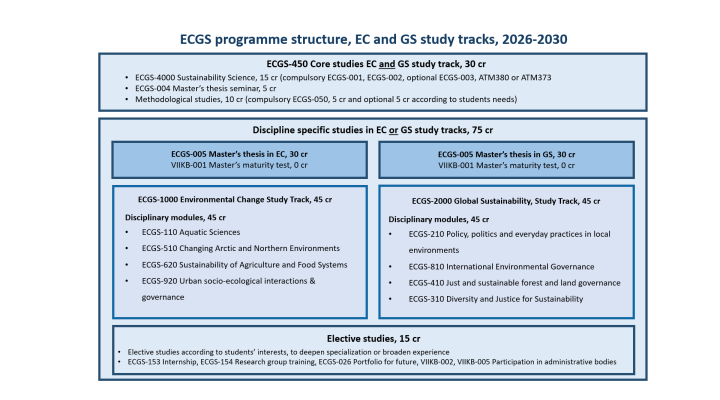
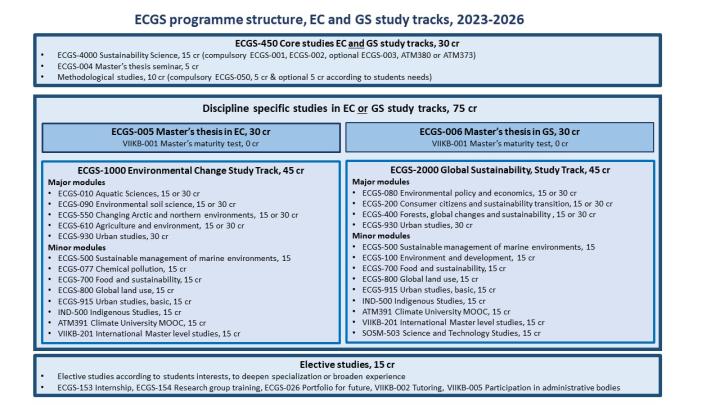
The AGRI-degree stucture 2026-2030 as a simplified pdf figure
(here is the previous degree structure 2023-2026 as a simplified pdf figure and degree structure 2020-2023 as a simplified pdf figure).

The AGRI degree structure 2023-2026 and a 2-years model study schedule as a detailed pdf table:  

(here is the previous degree structure 2020-2023 as a detailed pdf table).

You can also browse the degree programme's structures in the Degree Programme section of the Studies Service main menu. The previous degree structure is found in Sisu as a version 2020-2023.

Study Tracks

The programme has four study tracks (their respective modules are shown in parenthesis):

  • Agrotechnology (Agricultural Engineering and Environmental Technology in Agriculture)
  • Plant Production Sciences (Agroecology, Plant Breeding and Biotechnology, Crop Science, Plant Pathology, Agricultural Entomology and Horticulture)
  • Animal Sciences (Animal Breeding, Animal Nutrition and Animal Welfare and Health)
  • Environmental Soil Science

The study track can be changed during the MSc studies according to certain requirements. Information about the requirements for changing the study track can be found here.

Information Specific to Your Degree Programme

These instructions are available only in Finnish. For more information, please change the language of this page to Finnish.

Study track: Mathematics teacher

This information is not available in English. Please change the language of the page to Finnish for more information.

Information Specific to Your Degree Programme

These instructions are available only in Finnish. For more information, please change the language of this page to Finnish.

Study track: Chemistry teacher

This information is not available in English. Please change the language of the page to Finnish for more information.

Course offerings during the academic year

This information is not available in English. Please change the language of the page to Finnish for more information.

Qualifications

This information is not available in English. Please change the language of the page to Finnish for more information.

Information Specific to Your Degree Programme

Structure of Studies

Your degree will include 100-120 credits of  advanced courses. The amount of compulsory and optional advanced studies is different with each study track:

Advanced studies in the Study Tracks in Experimental Materials Physics, Computational Materials Physics, Medical Physics and Biophysics and Electronics and Industrial Physics include
  • 45 credits of compulsory advanced studies (studies common to all study tracks)
  • 55-75 credits of optional advanced studies
Advanced studies in the Study Track in Polymer Materials Chemistry include
  • 80 credits of compulsory advanced studies (45 cr of studies common to all study tracks and two compulsory course packages (total 35 cr))
  • 20-40 credits of optional advanced studies
Advanced studies in the Study Track in Inorganic Materials Chemistry include
  • 85-90 credits of compulsory advanced studies (45 cr of studies common to all study tracks, two compulsory course packages (total 30 cr) and one course package that you can choose from two options (10-15 cr))
  • 10-35 credits of optional advanced studies

The optional advanced studies can include whole course packages or individual courses related to your field of interest and as agreed in your personal study plan.

Other Studies

In addition to the beforementioned advanced studies, your degree will include 0-20 credits of other courses from your Master’s programme or other programmes. Other studies may include study modules or individual courses form other degree programmes to meet the minimum total number of credits required for your degree. Also practical training and language studies can be included.

Choosing Your Study Track

At the beginning of your studies you will make a personal study plan, with the help of teaching staff, where you choose your study track. Should you need to change your study track later on, please consult the instructions found here.

RPE and RPO Qualifications

Within the programme it is possible to obtain qualification as a radiation protection expert (RPE) and radiation protection officer (RPO). RPE and RPO are the official EU-wide names for personnel responsible for radiation protection in working environments.

The requirements for RPE and RPO will be defined before the end of 2017. Note that teaching for RPE and RPO is given in Finnish.

The education and examination are regulated by radiation authorities such as STUK.


Information specific to your degree programme

Information Specific to Your Degree Programme

Degree structure 2023-26 (pdf) valid starting from 1.8.2023

Degree structure 2026-30 (pdf) valid starting from 1.8.2026

List of replacing courses OPS 2026-30 (excel) 

Degree structure 2022-23 (pdf)

Note! FOR-109 Ecosystem services: a comprehensive introduction to theory and applications – course is not organized anymore. You can replace the course with ECGS programme’s courses or AGERE-003 Economic valuation methods -course (in 2. period) or with AGERE-011 Socio-cultural valuation methods for integrated landscape management -course (in period 1). If the course in in your elective advanced studies, agree with you PSP-teacher with which course you replace it.

Degree structure 2020-21 and 2021-22 (pdf) 

Descriptions of the study units as one report (pdf)

Study tracks

You choose your study track in the beginning of your studies. There are two study tracks in the master's degree programme:

  • Forest economics, business and society
  • Forest ecology and management

In Forest ecology and management study track there are also 7 specialization lines of which one is chosen.

Elective studies

There are 32 cr or 37 cr of elective studies in your degree depending on your study track. You can choose studies from forest sciences or from other degree programmes to your electives.

In student's instructions you can find all faculties elective courses offered in theme Optional studies.

You can also choose Unipid study module Sustainable development 25 cr in you electives.

Qualifications

You can get the title of a professional forester, if you complete basics studies in forest sciences in addition to the master's degree programme.

Information Specific to Your Degree Programme

This information is not available in English. Please change the language of the page to Finnish for more information.

Information Specific to Your Degree Programme

These instructions are available only in Swedish. For more information, please change the language of this page to Swedish.

Information Specific to Your Degree Programme

Faculty of Pharmacy

Instructions about degree structure are only in Finnish. You can see them by changing language at the top of this page.

Information Specific to Your Degree Programme

These instructions are available only in Finnish. For more information, please change the language of this page to Finnish.

Information Specific to Your Degree Programme

These instructions are available only in Finnish. For more information, please change the language of this page to Finnish.

Information Specific to Your Degree Programme

These instructions are available only in Finnish. For more information, please change the language of this page to Finnish.

Information Specific to Your Degree Programme

These instructions are available only in Finnish. For more information, please change the language of this page to Finnish.

Information Specific to Your Degree Programme

Structure of Studies (curriculums 2020 - 2023 and 2023 - 2026)

Your degree will include:

  • 90-120 cr of  advanced courses in the Master’s programme including
    • 35 cr of compulsory studies (= Master's thesis 30 cr and seminar 5 cr)
    • 55-85 cr of optional advanced studies

      The optional advanced studies can include whole course packages or individual courses related to your field of interest and as agreed in your personal study plan.
  • 0-30 credits of other courses from your Master’s programme or other programmes
    • Other studies may include study modules or individual courses form other degree programmes to meet the minimum total number of credits required for your degree. Also practical training and language studies can be included.

Modules

The programme does not have any study tracks; instead, you can tailor a suitable combination according to your plans and existing knowledge from the modules in physics, mathematics, chemistry, and computer science. Your personal study plan will ensure that your courses will form a functional combination.

Information Specific to Your Degree Programme

The degree structures for different years are shown at the end of this page.

In addition, you might find the following links useful:


Model study schedules

How are studies completed?

Master's thesis instructions


Information Specific to Your Degree Programme

The programme specific information for the Master's Programme in Translational Medicine (TRANSMED) is published exclusively in English.

Students who have started their studies before 1.8.2026 will have an opportunity to complete their studies according to their current 2023-2026 curriculum until 31 July 2028. A table indicating how to complete studies of the old curriculum during this transfer period can be found in the page Curriculum and Equivalence between curricula.

The 120 cr Master’s Degree in Translational Medicine includes

  • 32 credits of obligatory studies in Foundations in Translational Medicine. This includes also an obligatory career planning course which supports the choice of study track.
  • At least 68 credits of advanced studies, either in the study track Translational Research or in the study track Health Industry and Innovations. These advanced studies include a 30 cr Master’s thesis and a 5 cr Master’s thesis seminar.
  • Optional studies can be study track –specific or include suitable studies completed in another university or degree programme. Also transferable skills such as working life skills, language studies, studies in academic writing or studies in sustainability skills can be included.
  • The degree includes a personal study plan.

Cross-institutional studies (RIPA) and Flexible Study Rights (JOO)

Where possible, Master’s Programme in Translational Medicine participates in cross-institutional networks, which allow our students to complete some specified studies in other universities. The cross-institutional study opportunities may vary annually and are visible for students through Sisu (RIPA-studies).

The Finnish universities have withdrawn from the national Flexible Study Right (JOO) agreement starting from January 1, 2026. All study rights granted before 31.7.2025 will remain valid until the end of the granted study period.

Information Specific to Your Degree Programme

Information Specific to Your Degree Programme

Information for Curriculum 2026-2030

Curriculum 2026-2030

ECGS schedule 2026-2030

The ECGS degree structure in a table format


The Master's programme in Environmental Change and Global Sustainability offers three different degree titles: Master of Science, Master of Science (Agriculture and Forestry) and Master of Social Sciences. The degree title is determined by the student’s choice of disciplinary study module in their study plan. If the chosen module has two possible degree titles, the suitability of the chosen degree title is evaluated in relation to the study plan’s content and may also be assessed based on the potential thesis topic area. 

The corresponding degree titles for each study module are: 

Environmental Change:

  • Urban socio-ecological interactions & governance, Master’s degree in Science (M.Sc.)
  • Changing Arctic and Northern Environments, Master’s degree in Science (M.Sc.)
  • Aquatic Sciences, Master’s degree in Science (M.Sc.)
  • Sustainability of Agriculture and Food Systems, Master’s degree in Science (Agriculture and Forestry) 

Global Sustainability:

  • Policy, politics and everyday practices in local environments, Master’s degree in Social Sciences (M.Soc.Sc.)
  • International environmental governance, Master’s degree in Science (M.Sc.) or a Master’s degree in Science (Agriculture and Forestry)
  • Just and sustainable forest and land governance, Master’s degree in Science (Agriculture and Forestry)
  • Diversity and Justice for Sustainability, Master’s degree in Social Sciences (M.Soc.Sc.) or a Master’s degree in Science (Agriculture and Forestry)
In the ECGS programme structure, studies are divided into three sections:
  • Core studies 30 credits
  • Discipline-specific studies 75 credits
  • Elective studies 15 credits

Core studies consist of Sustainability Science module (15 cr), Methodology studies (10 cr) and the Master's thesis seminar (5 cr).

Discipline-specific studies consist of one disciplinary module (45 cr) and the master's thesis (30 cr). The disciplinary modules are chosen according to study track, which is already determined as a part of the application process. The two possible study tracks are Environmental Change (EC) or Global Sustainability (GS).

Elective studies may include for example; studies within the ECGS, studies from other Helsinki University programmes , studies in another University (JOO-studies) or exchange studies.

Teaching language in the programme is mostly English. However, all assignments, exams and dissertations can be done in English, as well as in Finnish and Swedish.

For more detailed information about the ECGS programme's modules and courses, see programme's Moodle site: ECGS Info site 2026-2030

Information for Curriculum 2023-2026

Curriculum 2023-2026

ECGS programme structure 2023_26_EC_GS

The Master's programme in Environmental Change and Global Sustainability offers three different degree titles: Master of Science, Master of Science (Agriculture and Forestry) and Master of Social Sciences. The degree title is determined by the study track and the discipline module completed in it, and in unclear cases, the topic of the master’s thesis and its supervisor.

In the Environmental change study track, the choice of Soil Science or Agricultural and Environmental Science modules leads to the title Master of Science (Agriculture and Forestry), the others lead to the title Master of Science .

In the Global sustainability track, the completion of the Forestry module leads to the Master of Science (Agriculture and Forestry) degree title, the Environmental Policy and Economics either to the Master of Science (Agriculture and Forestry), or Master of Social Sciences degree title, other modules in the track lead to the Master of Social Sciences degree title.

In the ECGS programme structure, studies are divided into three sections:
  • Core studies 30 credits
  • Discipline-specific studies according to study track 75 credits (including Master's thesis 30 cr)
  • Elective studies 15 credits

Core studies consist of the Sustainability Science module (15 cr), Methodology studies (10 cr) and the Master's thesis seminar (5 cr).

Discipline-specific studies are chosen according to study track, which is already determined as a part of the application process. The two possible study tracks are; the Environmental Change track (EC) and the Global Sustainability track (GS). 

  • International students in EC will be awarded the degree Master of Sciences. However, if they choose the module in Environmental Soil Science or Agriculture and Environment as part of their advanced studies, they will be awarded the degree of Master of Science (Agriculture and Forestry) upon their graduation.
  • International students in GS will be awarded the degree Master of Social Sciences. By choosing the module in Global Forestry Sustainability as part of their advanced studies, students will be awarded the degree of Master of Science (Agriculture and Forestry) upon graduation.

Students may choose one Major module of 30 credits, or two of them with 15 cr scope. In addition, one Minor module of 15 cr or one Major module of 15 cr is to be chosen.

Elective studies may include for example; studies within the ECGS, studies from other Helsinki University programmes , studies in another University (JOO-studies) or exchange studies.

Teaching language in the programme is mostly English. However, all assignments, exams and dissertations can be done in English, as well as in Finnish and Swedish.

For more detailed information about the ECGS programme's modules and courses, see programme's Moodle site: ECGS Info site 2023

Information for Curriculum 2020-2023

Curriculum 2020-2023

Information specific to your degree programme

Programme Structure

The credit requirement for the Master’s Programme in Urban Studies & Planning is 120 ECTS credits, which can be completed in two years. The degree consist of the following studies:

  • Core skills at methods coursework (20 ECTS)
  • Core Urban Challenge Studios (20 ECTS)
  • Specialization coursework (study track studies, 20-22 ECTS)
  • Electives (30 ECTS)
  • Master's Thesis (30 ECTS)

The studies are described in more detail on the programme’s webpage. The preliminary list of courses for the next academic year is updated by the end of March and it can be found in the course selection page.

Curriculum 2020-2023

The new curriculum for the USP study programme begins on August 1st 2020. The main changes for the curriculum 2020-2023 are:

  • Course selection expands both in the University of Helsinki and Aalto University
  • Study track is chosen during the first year of studies, not when applying to the programme
  • Each study track offers 6 courses (previously 4). As before, students must complete four study track courses, of which at least three must be from one study track
  • USP-302 Research methods course can be replaced with another methodology course listed in the curriculum
  • USP-405 Master’s seminar (10 cr) is completed in two parts (Autumn 5 cr, Spring 5 cr). The course remains optional but highly recommended.

To compare the curriculums 2017-2020 and 2020-2023 in detail, please see the correspondence table. Please note that some courses might have different codes or names for the next curriculum cycle. All USP students can begin to follow the new curriculum.

Target degrees

At the University of Helsinki, USP students can graduate from four different target degrees:

  • Master of Science (Faculty of Biological and Environmental Sciences)
  • Master of Science (Faculty of Science)
  • Master of Social Sciences (Faculty of Social Sciences)
  • Master of Arts (Faculty of  Arts [Humanities])

The target degree is to be selected in the application process and cannot be later changed.

Study tracks

The study programme has three study tracks:

  • Plans (Urban Planning and Design)
  • Peoples (Urban Life, Economy and Cultures)
  • Systems (Urban Ecologies and Systems)

Students choose to follow one study track during their first year of studies. You can read more about the study tracks on the programme website.

Studies at Aalto University

USP students at the University of Helsinki are entitled to enroll to USP courses at Aalto University. These are courses listed in the programme curriculum (see these Into-pages). In order to take other courses at Aalto University, students must apply for a JOO study right.

Information specific to your degree programme

De­gree struc­ture

General studies in the Master’s Programme 10-20 ECTS

  • Career Courses 5-15 cr: Traineeship 5-15 cr, Career-related Project 5-10 cr, Organisational Activities and Volunteer Work 5 cr or peer tutoring 5 cr
  • Academic writing 5 cr

Advanced Studies 60 ECTS
Study tracks: Global Development Studies, Social and Cultural Anthropology, Social and Public Policy, Social Data Science, Social Psychology, Sociology

Joint Studies 5 ECTS

  • COS seminar 5 cr

Study Track Specific Studies 55 ECTS

  • 15 ECTS advanced general studies in the discipline
  • 10 ECTS thesis seminar  
  • 30 ECTS Master’s thesis

Research Skills (quantitative and/or qualitative) 15 - 35 ECTS

Specialisation in thematic studies 15 - 35 ECTS 
Thematic studies: Data and Society; Ethnic Relations and Migration; Mind and Society; Socio-Cultural Shifts; Sources of Inequalities

Optional studies 0 – 20 ECTS
(Language studies and/or thematic courses of the student’s choice. Mobility window)

More detailed information is available on Sisu Degree Stucture page.

Student progress and study tracks

Timetable templates for study tracks:

Timetable

Students in all four study tracks complete basic studies in mathematics as well as intermediate studies in mathematics. During the first year, students complete not only basic studies in mathematics (25 cr), but also studies in other fields in accordance with their study plan. In the Study Track in Statistics and the Study Track in Econometrics, first-year students complete basic studies in statistics. In the Study Track in Theoretical Computer Science, first-year students complete basic studies in computer science. In the Study Track in Mathematics, studies in other fields may include study modules in statistics and computer science or other fields.

The prerequisite for the basic study modules in mathematics and statistics is the advanced syllabus in mathematics completed in general upper secondary school. This means that the basic studies in mathematics compulsory for all students are not a prerequisite for basic studies in statistics and computer science. The basic studies in these fields can – and should – be pursued alongside basic studies in mathematics. Students should not first complete basic studies in mathematics and only then pursue studies in statistics and/or computer science if these (or econometrics) are their prospective study tracks.

Intermediate studies in mathematics, statistics or theoretical computer science are founded on basic studies in mathematics, statistics and/or computer science.  In other words, in order to progress in the study tracks in statistics, econometrics and theoretical computer science, by the beginning of the second year of study all students must have completed basic studies in mathematics and basic studies in either statistics or computer science, or both. Studies in the study tracks in statistics, econometrics and theoretical computer science then continue with intermediate studies in mathematics, statistics, econometrics and/or theoretical computer science. In the Study Track in Mathematics, students continue to pursue studies in mathematics and in their selected study track.

Econometrics does not diverge from statistics until after intermediate studies in statistics. Basic studies in econometrics are a short version of intermediate studies in statistics.

If you select the Study Track in Mathematics, you do not have to complete intermediate studies in statistics or theoretical computer science. However, in the Study Track in Mathematics, you must complete at least basic studies in another field. This may be statistics or computer science, both of which are offered by the degree programme. This means that basic studies in either of these, completed during the first year, are not wasted, but rather are part of the degree. The other compulsory field can also be from another degree programme. If you are certain of selecting mathematics as your study track and are definitely interested in a field other than statistics and/or computer science, you should study the other field alongside your studies in mathematics during your first year. Studies in mathematics do not meet the target for the first year (approx. 60 cr) because you must complete basic studies in mathematics (25 cr) before embarking on intermediate studies in mathematics, which cannot, in practice, be pursued until the second year of study.

You can find a detailed description on the programme website.


Information Specific to Your Degree Programme

The programme structure, study tracks, specializations and degree requirements are explained here on the programme webpages.

Information Specific to Your Degree Programme

The Master´s programme comprises of 120 credits and it is possible to complete the degree in two years, in accordance with an approved personal study plan. The degree includes

85 cr of advanced courses, including

  • shared courses within the programme
  • study track specific courses within the programme
  • the Master’s thesis, 30 cr
  • thesis seminar which includes study orientation 5 cr

35 cr of other courses from your own or other programmes,

The programme gives introductory courses from study tracks. During the first half year of studies, the student should be ready to choose his/her own study track.

Study tracks in Life science informatics are given on the degree programme's public website.

Information Specific to Your Degree Programme

These instructions are only available in Finnish. If you have questions, please contact siltavuori-student@helsinki.fi

Information Specific to Your Degree Programme

These instructions are only available in Finnish. If you have questions, please contact siltavuori-student@helsinki.fi

Information Specific to Your Degree Programme 

These instructions are only available in Finnish. If you have questions, please contact siltavuori-student@helsinki.fi

Information Specific to Your Degree Programme

These instructions are only available in Swedish. If you have questions, please contact siltavuori-student@helsinki.fi

Information Specific to Your Degree Programme

Structure of the Master's Programme

The Master’s Programme in Intercultural Encounters (120 cr) consists of the following studies

  • Joint Studies, 25 cr (including the Seminar 5 cr)
  • Master’s Thesis, 30 cr
  • Professional Contexts, 10 cr
  • Thematic Studies, 30 cr
  • Optional Studies, 25 cr

Study Tracks

Depending on your target degree, you will follow either the Master of Arts, or the Master of Theology track. The programme structure is different only in the Thematic Studies. If your target degree is Master of Arts, you will choose two thematic modules of 15 cr. If your target degree is Master of Theology, you will specialise in the thematic module Religion and Diversity (30 cr).

All students may choose an additional module in their optional studies. Alternatively, the Optional Studies may include language studies, exchange studies, optional modules, or individual courses offered by other programmes.

Timing

Your studies in the Master’s Programme start with the obligatory introductory courses Intercultural Encounters: Interdisciplinarity and Concepts, and Intercultural Communication. We strongly advise you to start your thematic studies during the first term. We also advise that you complete at least 60 credits during the first year.  

Changing study tracks while pursuing a degree

Depending on your target degree, you will follow either the Master of Arts, or the Master of Theology track. You will choose the track when you apply to the programme and it is not possible to change the track during your studies.

Information specific to your degree programme

During your Master’s studies, you will focus mainly on advanced level studies in educational sciences, deepening your knowledge through coursework and writing your Master’s thesis. To help you complete your studies, you will be assigned a personal advisor who will help you prepare a personal study plan at the beginning of your Master’s studies.

Teaching is arranged during the teaching periods. You can find information on the teaching periods on the Instructions of Students page academic year and teaching periods.

Planning your studies and model timing

The model timing works as a tool to help you plan your studies. The pedagogical progress of the studies and an even distribution of the workload for students have been considered in the model timing. By following the model timing, you complete all studies in the target time. You can also find the model timing in Sisu.

Please find here the model timing 2024-2026 (pdf)

If you have concerns related to the structure of the studies or course selection, please contact siltavuori-student@helsinki.fi.

In curriculum period 2023-2026, the degree consists of the following studies:

Advanced studies in the educational sciences (90 credits)

Courses in research work and methodology (50 credits)

  • Topical Issues in Educational Research (5 cr)
  • Qualitative Research Methods II (5 cr)
  • Quantitative Research Methods II (5 cr)
  • Master’s Thesis (30 cr) + Seminar (5 cr)

Content courses in Educational Sciences (40 credits)

  • Orientation to Research in Changing Education (5 cr)
  • Uncover Finnish Education I & II (5 cr)
  • Challenging Education and Inequalities (5 cr)
  • Education and Global Justice (5 cr)
  • Neuroscience in Educational Sciences (5 cr)
  • Educational Psychology as an Engine for Change (5 cr)
  • Curriculum Theory: Understanding Curriculum and Education Policy (5 cr)
  • Antiracism in Education (5 cr)
Other compulsory courses (10 credits) 
  • Professional Identity in Changing Education (5 cr)
  • Academic Writing I, Academic Writing II, Feedback on Writing (total 5 cr)
Optional studies (20 cr) in educational sciences or other disciplines

Faculty of Educational Sciences offers several optional courses you can choose from. Please find the selection of the courses on the page Optional studies in the Faculty of Educational Sciences

You can also include optional studies in related disciplines, an internship and a student exchange period as part of your degree. If you plan to study abroad or attend an internship please plan it at the beginning of your studies. 

After the first study year it is possible to choose as an optional course: Orientation to working life (5 cr) or Traineeship course (10 cr).

Traineeship

Find more information on traineeship possibilities from here.

Study abroad

Do you wish to study abroad. Plan your study abroad period already at the beginning of your studies. Please find more information on the page Do you want to study abroad? For more information on student exchange opportunities please contact the mobility advisors at International Exchange Services.

Information Specific to Your Degree Programme

These instructions are only available in Swedish. If you have questions, please contact siltavuori-student@helsinki.fi

Information Specific to Your Degree Programme

These instructions are available only in Swedish. For more information, please change the language of this page to Swedish.

Information Specific to Your Degree Programme

These instructions are only available in Finnish. If you have questions, please contact siltavuori-student@helsinki.fi

Information related to your study track

These instructions are only available in Finnish. If you have questions, please contact siltavuori-student@helsinki.fi

Information Specific to Your Degree Programme

This information is not available in English. Please change the language of the page to Finnish for more information.

Information Specific to Your Degree Programme

These instructions are available only in Finnish. For more information, please change the language of this page to Finnish.

Information Specific to Your Degree Programme

Bachelor's Programme in Science comprises 180 credits, which can be completed in three years, in accordance with an approved personal study plan. The degree includes:

  • 15-30 credits of mandatory studies in basic math, basic computer science and statistics
  • 25 credits of mandatory common studies: language and communication skills, career orientation and professional skills, ICT skills and a group work course introducing modern science.

    Language studies comprise 10 credits: 4 credits of academic English and 6 credits of basic courses in Finnish or Swedish (for students with Finnish or Swedish as secondary education language, 3 credits of Finnish and 3 credits of Swedish at an advanced level)
  • At least 60 credits of study track specific basic and intermediate studies
  • 10 credits of a final seminar (4 cr) and bachelor's thesis (6 cr)
  • At least 35 credits of other courses according to study track requirements and personal study plan

You can find the degree structure underneath this chapter.


Students admitted to the Bachelor’s Programme in Science have the right, after completion of the BSc degree, to continue in one of ten Master's programmes at the Faculty of Science, at Faculty of Arts or Faculty of Social Sciences. These programmes cover the full range of modern natural sciences from pure math to chemistry and are, with the exception of the specialisation lines, taught in English. Principles for continuing studies at Master's programme after completing a degree in Bachelor's Programme in Science can be found at Right to complete a Master's degree page. 


Information specific to your degree programme

Structure of the HNFB-programme

HNFB programme structure 2023_26


Curriculum 2020-2023 pdf

HNFB_Curriculum_ 2023-26_en.pdf

Information Specific to Your Degree Programme

This information is not available in English. Please change the language of the page to Finnish for more information.

Structure of your degree programme

This information is not available in English. Please change the language of the page to Finnish for more information.

Information Specific to Your Degree Programme (SBP flerform)

These instructions are only available in Swedish.

Koulutusohjelmasi erityispiirteet (VO sosionomimonimuotokoulutus)

Opintojen suunnittelu ja malliajoitus VO sosionomimonimuotokoulutuksessa

Opintojen suunnittelun apuna toimii opintojen ajoitustaulukko eli malliajoitus, jossa on opintojen suunniteltu suoritusjärjestys. Malliajoituksessa on huomioitu opintojen pedagoginen jatkumo, opintojaksojen edeltävien opintojen vaatimusten täyttyminen sekä opiskelijan työmäärän tasainen jakautuminen. Huomaathan, että malliajoitus on suunniteltu koko tutkintosi ajalle, mutta siihen voi tulla vuosittain tarkennuksia opetusohjelman tarkentamisen yhteydessä (kuten opintojaksojen liikkumista periodista toiseen tms.), joten tarkistathan voimassaolevan opintopolun seuraavalle lukuvuodelle ennen opintojesi aloittamista.

VO sosionomimonimuotokoulutuksen malliajoitus päivitetään sivulle kesäkuuhun 2025 mennessä.


Lukukauden 2025-2026 ilmoittautumisajat (VO sosionomimonimuotokoulutus)

Ilmoittautumisajat päivitetään sivulle kesäkuuhun 2025 mennessä


Terveydenhuollon kehittämisen maisteriohjelman rakenne

These instructions are available only in Finnish. For more information, please change the language of this page to Finnish.

Structure of your degree programme

Your own programme's full degree structure is available at the top of the page in the main menu of the Studies Service, under the heading Degree Structure.


Information specific to your degree programme

These instructions are available only in Finnish. For more information, please change the language of this page to Finnish.

Information specific to your degree programme

These instructions are available only in Swedish. For more information, please change the language of this page to Swedish.

Special features in medicine studies

This information is not available in English. Please change the language of the page to Finnish for more information.

Koulutusohjelmasi erityispiirteet

Profiili

Koulutamme tutkittuun tietoon perustuen hammaslääkäreitä, jotka toimivat potilaiden ja yhteiskunnan parhaaksi ja joilla on edellytykset jatkokoulutukseen, tieteelliseen työhön ja elinikäiseen oppimiseen.

Hammaslääketieteen koulutus järjestetään lääketieteen ja hammaslääketieteen kandiohjelmassa hammaslääketieteen opintosuunnassa, sekä hammaslääketieteen lisensiaattiohjelmassa.

Hammaslääketieteen kandiohjelma valmistaa opiskelijoita hammaslääketieteen lisensiaattiopintoihin. Hammaslääketieteen lisensiaattiohjelmassa annetaan syvällinen asiantuntemus ja erikoistunut osaaminen sekä valmiudet toimia hammaslääkärin kliinisessä työssä sekä riittävä perusta tohtorikoulutukseen tai erikoistumiskoulutukseen hakeutumiseen. Tämä edellyttää akateemisia taitoja, kliinisiä kädentaitoja sekä hyviä vuorovaikutustaitoja. Hammaslääketieteen lisensiaattiohjelma johtaa hammaslääketieteen lisensiaatin (HLL) tutkintoon ja valmistaa opiskelijat lakisääteiseen hammaslääkärin ammatin harjoittamiseen. Koulutuksen tavoitteena on antaa opiskelijoille edellytykset ja riittävä osaaminen toimimiseen sosiaali- ja terveydenhuollon monenlaisissa hammaslääkärin tehtävissä. Hammaslääkärin työn keskiössä on potilaan kohtaaminen ja hoito. Valmistuneen hammaslääkärin tulee kehittää omaa ammatillista osaamistaan koko työuransa ajan. Hammaslääkärin toimintaa ohjaavat ammatilliset arvot, jotka kehittyvät opintojen aikana. 

Osaamistavoitteet

Hammaslääketieteen kanditutkinnon suoritettuaan opiskelija osaa

  • kuvailla ihmisen elimistön rakenteet ja toiminnan molekyylitasolta lähtien
  • selittää sairauksien patofysiologisen perustan
  • selittää lääkeaineiden vaikutusmekanismeja, metaboliaa ja käyttöä sairauksien hoidossa
  • tulkita miten perimä ja fyysinen sekä sosiaalinen ympäristö vaikuttavat terveyteen, hyvinvointiin ja sairauksiin
  • selittää taudinaiheuttajat, mikrobiomin ja niiden aiheuttamat muutokset elimistössä
  • kuvailla kliinisen päättelyn ja päätöksenteon periaatteet
  • tunnistaa lääketieteellisen tutkimustyön perusteet ja näyttöön perustuvan lääketieteen periaatteet
  • haastatella ja tutkia potilaan ja laatia tämän pohjalta sairauskertomusmerkintöjä
  • tunnistaa sairauksien hoidon suunnittelun periaatteet
  • selittää terveydenhuoltoon liittyviä eettisiä, taloudellisia ja yhteiskunnallisia ulottuvuuksia myös globaalista näkökulmasta ja ymmärtää kestävän kehityksen periaatteet
  • perustella hyvän ammatillisen vuorovaikutuksen ja toiminnan vaikutukset potilaan hoitoon ja lääkärintyöhön sekä soveltaa niitä omassa toiminnassaan
  • selittää ennaltaehkäisyn ja elintapojen merkityksen sairauksien kehittymisessä
  • kuvailla suomalaisen terveydenhuoltojärjestelmän perusteet
  • tunnistaa suun tavallisimmat biofilmitaudit ja osaa diagnosoida ja toteuttaa näiden tautien hallintaa ja hoitoa käytännössä perustasolla

Geneeristen osaamistavoitteiden osalta hammaslääketieteen kanditutkinnon suoritettuaan opiskelija osaa

  • arvioida tietoja kriittisesti
  • soveltaa tieteellistä ajattelu- ja toimintatapaa sekä luovaa ongelmanratkaisua erilaisissa tehtävissä
  • suunnitella, toteuttaa, arvioida ja kehittää asiantuntijuuttaan itsenäisesti sekä yhteistyössä toisten kanssa työskennellä rakentavasti monialaisissa ja -tieteisissä tiimeissä arvostaen kaikkien ryhmän jäsenten työpanosta
  • viestiä sujuvasti suullisesti ja kirjallisesti sekä verkkopohjaisissa keskusteluissa omaan osaamiseen liittyvissä kysymyksissä

Geneeristen osaamistavoitteiden osalta hammaslääketieteen lisensiaattitutkinnon suoritettuaan opiskelija osaa

  • Arvioida tietoja kriittisesti ja analyyttisesti
  • Työskennellä tehokkaasti monialaisissa ja -tieteisissä tiimeissä ja ryhmissä arvostaen kaikkien tiimin jäsenten työpanosta
  • Viestiä työyhteisössä suullisesti, kirjallisesti sekä verkkopohjaisissa keskusteluissa
  • Edistää vuorovaikutusta monikulttuurisessa terveydenhuollossa, sekä potilaan hoidossa että työyhteisöissä.
  • Antaa ja ottaa vastaan rakentavaa palautetta sekä edistää työyhteisön palautekulttuuria.

Hammaslääketieteen kansallisten osaamistavoitteiden pohjana ovat yhteiseurooppalaiset tavoitteet, jotka on laatinut Association for Dental Education in Europe (ADEE). Helsingin yliopiston hammaslääketieteen koulutusohjelman yleiset tavoitteet pohjaavat hammaslääketieteen kansallisiin osaamistavoitteisiin. Sen lisäksi on oppialakohtaisia osaamistavoitteita. Valmistuvan hammaslääkärin osaamistavoitteet on kuvattu lääketieteellisen tiedekunnan verkkosivuilla: Hammaslääketieteen koulutusohjelman kliiniset osaamistavoitteet | Lääketieteellinen tiedekunta | Helsingin yliopisto (helsinki.fi(aukeaa uuteen välilehteen)). Osaamistavoitteet muodostavat kokonaisuuden, eikä niissä eroteta kandi- ja lisensiaattivaiheita.

Kestävyysosaaminen

Osana vapaasti valittavia opintoja opiskelijalla on mahdollisuus suorittaa itseopiskeluna SUST-001 Kestävyyskurssi -opintojakso.

Koulutusohjelman kannalta keskeisimpiä YK:n kestävän kehityksen tavoitteita ovat kohdat 3 terveys ja hyvinvointi, 4 hyvä koulutus, 5 sukupuolten välinen tasa-arvo, 6 puhdas vesi ja sanitaatio sekä 10 eriarvoisuuden vähentäminen.


Bachelor's programme in Medicine and Dentistry: Structure

This information is not available in English. Please change the language of the page to Finnish for more information.

Hammaslääketieteen lisensiaattiohjelman rakenne

Tutkinnon laajuus on 150 opintopistettä. Tutkinto koostuu opintovuosikohtaisista kokonaisuuksista, pakollisesta harjoittelusta, tutkielmasta sekä vapaavalintaisista opinnoista.

Syventävät opinnot hammaslääketieteen lisensiaattiohjelmassa:

  • hammaslääketieteen kliiniset ja teoreettiset syventävät opinnot (96 op)
  • syventävä tutkielma (20 op)
  • syventävät valinnaiset opinnot (4 op)
  • syventävä käytännön harjoittelu (30 op)

Lääketieteiden aloilla tutkielman laajuus on 20 op. Tutkielman tavoitteena on kehittää opiskelijan kykyä itsenäiseen tiedon hankintaan, jäsentelyyn sekä kirjalliseen ja tieteelliseen ilmaisuun. Muita tutkielman tavoitteita ovat tiedon kriittinen arviointi sekä uuden tiedon tuottaminen ja soveltaminen.

Lukuvuodelta toiselle siirtymisen vaatimukset

Lukuvuodelta toiselle siirtymisen vaatimukset

H4

Opintovuodelle H4 siirryttäessä opiskelijalla tulee olla kaikki kanditutkintoon kuuluvat hammaslääketieteen opetukset hyväksytysti suoritettuna. Kanditutkinto tulee olla suoritettuna viimeistään H4 keväällä, H5 opintojaksoille ilmoittauduttaessa.

Licentiate's programme in Medicine: Structure

This information is not available in English. Please change the language of the page to Finnish for more information.

Requirements for moving from one study year to another

This information is not available in English. Please change the language of the page to Finnish for more information.

Advanced and optional studies

This information is not available in English. Please change the language of the page to Finnish for more information.

Information specific to your degree programme

These instructions are available only in Finnish. For more information, please change the language of this page to Finnish.

Qualifications related to your degree

This information is not available in English. Please change the language of the page to Finnish for more information.

MBDP degree structure

Programme-specific information

See an example of course selections (general track) (pdf) and an example of course selections (research track) (pdf).

Teaching in the programme is partly arranged in cooperation with the departments of economics of Aalto University and Hanken School of Economics, which together with the Discipline of Economics at the University of Helsinki form the Helsinki Graduate School of Economics (Helsinki GSE). Although each university has their own Master’s Programme in Economics, with its own degree requirements, the cooperation enables attractive and versatile study opportunities, where you can tailor your studies according to your personal interest and career plans.

Courses included in the teaching cooperation are listed on the GSE website. If you would like to count the credits towards your degree, please check your curriculum or contact student advice via HelsinkiUni Help

Advanced optional studies

This information is not available in English. Please change the language of the page to Finnish for more information.

Qualifications

This information is not available in English. Please change the language of the page to Finnish for more information.

Information Specific to Your Degree Programme

The structure of the programme (2023-2026)

Degree structure of the Master's Programme in Neuroscience


Neuro programme_structure_2023-26.pdf

Curriculum 2023-24 printout (pdf 17.3.2023, 96 pages)


Choosing Your Study Track

In the Master’s Programme in Neuroscience, you choose from two study tracks:

(1) Neuroscience 

(2) Cell and Systems Physiology 

Your selection is not binding until you work on your thesis.

Students studying for qualification as Biology teachers specialise in either Neuroscience or Cell and Systems Physiology. See more information on this by changing the page language to Finnish.


Study programme languages

Master’s Programme in Neuroscience is a multilingual study programme, where you can complete your courses in Finnish, Swedish or English, depending on what the language of your degree is. If you are taking an English-language degree, you are required to complete at least 75% of your degree components in the English language. Your thesis must also be written in English.

More information about the study programme languages


Information Specific to Your Degree Programme

Second year of the IMESS programme at the University of Helsinki (60 ECTS)

In Helsinki, the students will continue to study in their distinct study tracks (History and Society, Politics and the International Economy, and Politics and Security). The main task of the IMESS student during her second year in Helsinki is to write her master’s thesis. The dissertation is the most important part of the IMESS programme and showcases the sum of student’s achievements during the two-years of study. Working on their Master’s thesis, students will be pursuing original research on a topic of great personal interest. It will also equip students with invaluable skills for student’s future career, either in high level public and private sector institutions or in academia. The study programme of the second year In Helsinki is delivered through a combination of lectures, seminars, and research supervision.

1. Year two compulsory modules (52 ECTS or 40 ECTS if no language taken)

  • Language (0 or 12 ECTS)

New language at Intermediate or Beginners level

Note: If no language taken in year 1, compulsory in year 2 in Helsinki.

  • Master’s thesis seminar I and II (10 ECTS) and Thesis (30 ECTC).

2. Year two Optional modules  (8 ECTS or 20 ECTS if no language taken)


IMES-H300 History and Society Track

  • YMV-P509, Welfare State (5 ECTS)
  • YMV-P508, Politics of History (5 ECTS)
  • YMT-3510, Global Consumption (5 ECTS)
  • YMT-3512, Gender, Sexuality and Society (5 ECTS)
  • YMT-3504, Advanced Qualitative Methods (5 ECTS)
  • YMP-3405, Historical Theory and Methodology (5 ECTS)
  • YMP-3405, Political Thinking and Meaning of Politics (5 ECTS)
  • YMP-3401, State and Political Action (5 ECTS)
  • YMV-P507, Political Ideas (5 ECTS)
  • YMT-3507, Advanced Seminar in Social History (5 ECTS)
  • YMV-P511, Political Movements (5 ECTS)
  • YMV-P503, Conceptual History (5 ECTS)
  • Other approved Optional Modules (5-20 ECTS)


IMES-E300 Politics and the International Economy track

  • YMV-P509, Welfare State (5 ECTS)
  • YMV-T511, Social science history perspectives to business (5 ECTS)
  • YMT-3502, Economic Inequality (5 ECTS)
  • YMT-3510, Global Consumption (5 ECTS)
  • YM-310, Grand Problems in Social Theory (5 ECTS)
  • YMV-T505, Historical Perspectives on Consumer Society (5 ECTS)
  • YMV-T510, Nature, Society and Work (5 ECTS)
  • YMT-3511, Environmental History (5 ECTS)
  • YMT-3503, Crises, Conflicts and Ruptures (5 ECTS)
  • YMV-A517, Regional Focus on Society and Change (5 ECTS)
  • YMV-T509, Work and Living (5 ECTS)
  • Other approved optional modules (5-20 ECTS)


IMES-P300 Politics and Security track

  • YMV-P508, Politics of History (5 ECTS)
  • YMV-T514, Immigration and Borders (5 ECTS)
  • YMP-3402, International and Global Organisation (5 ECTS)
  • YMV-P501, Globalization and Transnationality: Historical Approaches (5 ECTS)
  • YMV-P506, Imperialism and Integration (5 ECTS)
  • YMV-P505, Nationalism and Nationhood (5 ECTS)
  • YMT-3504, Advanced Qualitative Methods (5 ECTS)
  • YMP-3404, Presence of the Past and Memorial Policy (5 ECTS)
  • YMV-P514, Topical Themes of Historical Policy Research (5 ECTS)
  • YMV-P514, The Approaches of Historical Policy Research (5 ECTS)
  • YMP-3405, Historical Theory and Methodology (5 ECTS)
  • Other approved optional modules (5-20 ECTS)

Information Specific to Your Degree Programme

Structure of the studies

YEAR 1 (60 cr)

   
Competence portfolio 0 cr    

Fall semester:

   
Drug development and use 25 cr Research orientation 5 cr  
Selection of study track:    
1. Drug design and pharmacology 2. Drug delivery and development 3. Medication safety and effectiveness

Spring semester:

   
Methodological studies 10 cr Literature review 9 cr Research ethics 1 cr
Optional studies 10 cr    

YEAR 2 (60 cr)

   
Advanced studies 20-30 cr Transferable skills 0-10 cr = total of 30 cr
Master's thesis 30 cr    


Bachelor of Medicine

These instructions are available only in Finnish. For more information, please change the language of this page to Finnish.

Information Specific to Your Degree Programme

These instructions are available only in Finnish. For more information, please change the language of this page to Finnish.

Koulutusohjelmasi erityispiirteet

Koulutusohjelmasi erityispiirteet